Autonomy over Independence, or the Wilsonian Moment in western Europe

A new publication and a new conference presentation by the MoH Team

Many people know the Spanish north-western city of Girona for one of three things: it has offered some of its breathtaking corners to the famous TV series Game of Thrones; it is home to former Catalan President Carles Puigdemont (who has been living in Belgium since the 2017 attempt of his government to convert Catalonia into an independent country); and, in the late 2000s, Ryanair turned its airport into the main gateway to the Costa Brava.

On 2-3 November 2023, the city also became the venue of an international conference on the topic of Global Wilsonism and its Impact on Europe and America. The event gathered about 15 researchers working on different aspects of the so-called Wilsonian Moment, that is a moment between the end of 1918 and the first half of 1919, when President Woodrow Wilson briefly turned into a symbol of peace, justice and self-determination around the world.

In this context, Emmanuel presented a paper written with Mona and entitled Autonomy over Independence: Self-Determination in Catalonia, Flanders, and South Tyrol in the Aftermath of the Great War. The paper argues that, while the impact of the postwar spread of self-determination on the redrawing of eastern European borders and on the claims of colonial independence movements has been extensively researched, the international historiography has paid little attention to minority nationalist movements in western Europe. The text thus focuses on three regions (Catalonia, Flanders and South Tyrol) that experienced considerable sub-state national mobilisation in the interwar period and aims to understand whether the leaders of western European minorities and stateless nations shared the same enthusiasm as their anti-colonial and eastern European counterparts for the new international order that self-determination seemed to foreshadow in the months following the end of the First World War.

The article concludes that nationalist forces in Catalonia, Flanders and South Tyrol initially mobilised self-determination and referred to Wilson as a symbol of national liberation, but this instrumentalisation of self-determination was not sustained. Large-scale mobilisation occurred only in Catalonia, and, even there, it disappeared suddenly in spring 1919. Furthermore, sub-state nationalist movements in western Europe tended to mobilise self-determination to gain regional autonomy, rather than full independence. The willingness of these movements to privilege autonomy over full independence made them more receptive to compromise. Radical forces would become stronger only in the 1930s and largely for reasons not directly connected to the post-war mobilization around self-determination.

The presentation shortly followed the publication of the paper in issue 53(4) of European History Quarterly in October 2023. The paper is available in open access at the journal’s website: https://journals.sagepub.com/doi/full/10.1177/02656914231198182
Tracking ‘minority’ in Estonia

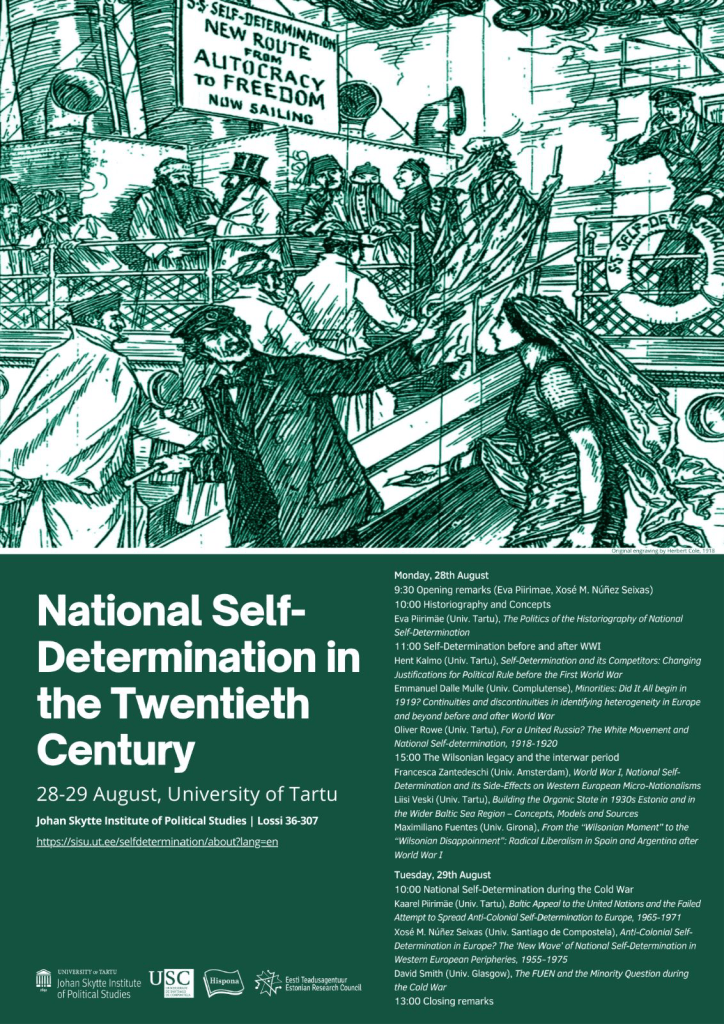
Emmanuel presented on the history of the term ‘minority’ at the workshop National Self-Determination in the 20th Century held at the University of Tartu

In the the 1920s and early 1930s, Estonia was a leader in minority protection in Europe. In 1925, the young republic adopted a law on non-territorial autonomy that, until the 1934 coup d’état, granted minority groups with at least 3,000 members the possibility to create institutions that could manage education and cultural affairs. Given this tradition, it is an ideal place to study issues concerning diversity, recognition, and individual and collective rights.

On August 28-29, researchers from all over Europe gathered at the Johan Skytte Institute of Political Affairs of the University of Tartu to discuss the origins, evolution and complexities of the principle of self-determination. Emmanuel presented a paper entitled “Did it all begin in 1919? A history of the term minority as a category of practice from the 18th century to the interwar period”.

Until recently, Emmanuel argues, the history of minorities and minority rights has followed a fairly standard account. Begun in Europe with the religious wars of the 16th and 17th century, minority protection developed further in the 19th around the Eastern Question and peaked in the immediate aftermath of the First World War, with the minority treaties negotiated at Versailles (there is a second part of the story after 1939, but this does not concern us here). This account has now come under attack. Several authors affirm that until 1919 the term minority, meant as a permanent not a transient minority, was marginal, if not absent, in domestic and international discourses on diversity. Emmanuel shows that revisionist authors have too quickly dismissed the relevance of much of the 19th century for the history of minorities and minority rights. Above all, they have missed an opportunity to explore in depth alternative trajectories to the traditional central and eastern European story. Emmanuel’s paper is a first attempt to draw such an alternative itinerary. Examining a broad range of sources, from parliamentary debates on Ireland and Canada, to demographic and statistical analyses on the populations of the German and Habsburg empires, the paper tracks how philosophers, politicians, geographers and statisticians anticipated a world in which nationality conflicts would play out in the emerging grammar of minorities and majorities. It further suggests that two forces in particular drove the process: political representation, with its imperative of majority rule and the cognate question of minority rights; and census practices, which increased the legibility of the social, constructed difference and fuelled anxiety about numerical superiority and inferiority. The paper received useful feedback that will certainly help improving the final version.

The workshop covered a broad range of topics, from pre-First World War principles of political legitimacy alternative to self-determination to attempts to mobilise anti-colonial self-determination in the soviet space in the 1960s, through the rejection of self-determination by the White Movement during the Russian Civil War and the impact of the Wilsonian Moment in Argentina. In line with the core arguments of the Myth of Homogeneity project, the different contributions confirmed that self-determination, minorities, multi-ethnicity and plurinationalism are realities that extend, and have extended in the past, well beyond central and eastern Europe.

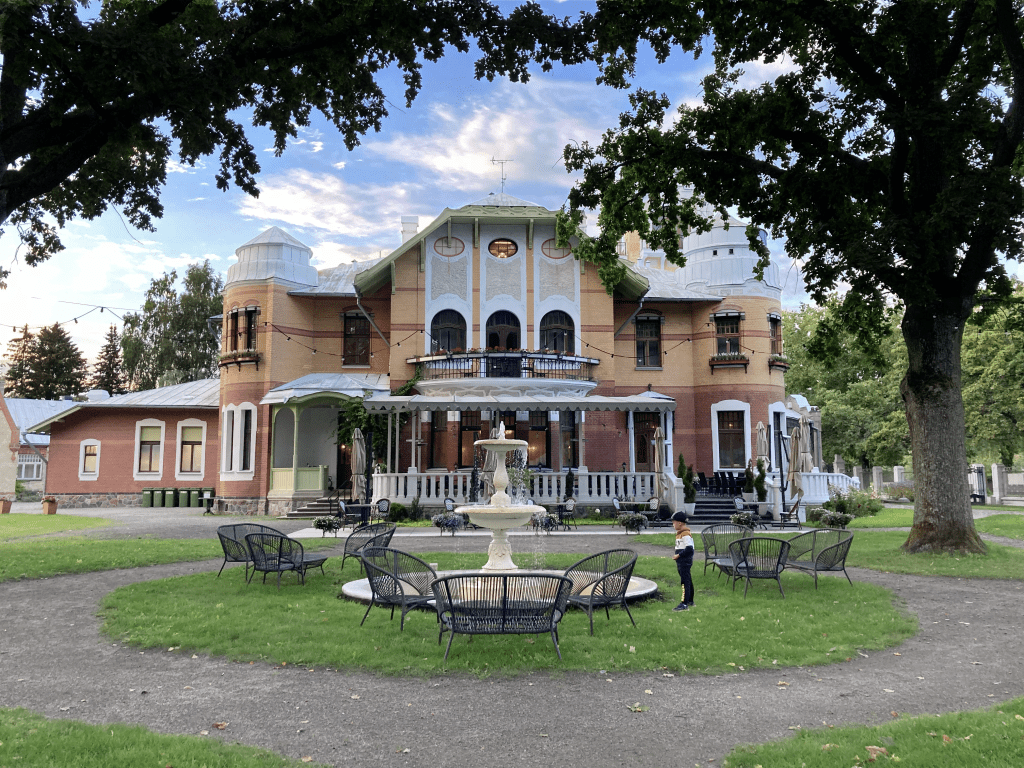
The conference was also the occasion for a visit at the Villa Ammende, in Parnu (pictured above). The house is a fine example of Art Nouveau architecture and, until 1927, the summer residence of the Ammende family. Ewald Ammende, founder of the interwar Congress of European Nationalities, spent many summers there, probably discussing about minority rights in the garden terrace. He still watches discretely the guests visiting the house from a hidden corner in one of the many dining rooms.

The Wilsonian Moment in Catalonia, Flanders and South Tyrol

Or how sub-state national mobilisation occurred, but it was more fleeting than minority nationalist leaders would have hoped for

On the 100th anniversary of the Paris Peace Conference, in 2019, Emmanuel and Mona presented a paper at the 29th Annual Conference of the Association for the Study of Ethnicity and Nationalism (ASEN) examining whether there was a ‘Wilsonian Moment in Western Europe’. A revised version of that paper has now been accepted for publication in European History Quarterly and it is due to appear online and in print in 2023. The paper entitled ‘Autonomy over Independence: Self-Determination in Catalonia, Flanders and South Tyrol in the Aftermath of the Great War’ (and available in pre-print here) fills an important gap in the historiography of self-determination in the immediate post-WWI period.

While the impact of the post-war spread of self-determination on the re­­drawing of Eastern European borders and on the claims of colonial independence movements has been extensively researched, the international historiography has paid little attention to minority nationalist movements in Western Europe. Focusing on three regions (Catalonia, Flanders and South Tyrol) that experienced considerable substate national mobilisation between the world wars, Emmanuel and Mona inquire into whether the leaders of Western European minorities and stateless nations shared the same enthusiasm as their anti-colonial and Eastern European counterparts for the new international order that self-determination seemed to foreshadow in the months following the end of the Great War. Since President Woodrow Wilson stood out as the most prominent purveyor of the new international legitimacy of self-determination, the article further examines how Western European nationalist movements exploited Wilson’s image and advocacy to achieve their own goals.

Emmanuel and Mona conclude that nationalist forces in Catalonia, Flanders and South Tyrol initially mobilised self-determination and referred to Wilson as a symbol of national liberation, but this instrumentalisation of self-determination was not sustained. Large-scale mobilisation occurred only in Catalonia and, even there, it disappeared almost overnight in spring 1919. Furthermore, substate nationalist movements in Western Europe tended to mobilise self-determination to gain regional autonomy, rather than full independence, thus pursuing internal, not external, self-determination. The willingness of these movements to privilege autonomy over full independence made them more receptive to compromise solutions and radical forces became stronger only in the 1930s, largely for reasons not directly connected to the post-war mobilisation around self-determination.

In other words, the wave of unprecedented international legitimacy for national self-determination claims inaugurated at the end of WWI did extend to Western Europe. It was not a uniform phenomenon, but a mix of different local attempts to mobilise the new language of self-determination that however did not last as long, and were not as powerful, as the leaders of Western European minority nationalist movements would have wished.