Emmanuel presented a chapter of his new monograph at the University of Stockholm
Comparative analyses of minority policies in central and eastern Europe during the interwar period abound. Few authors however have thought of including western European countries in the picture. In the second chapter of the monograph that he is currently writing, The Myth of Homogeneity: Minority Questions in Interwar Western Europe, Emmanuel includes Belgium, Italy and Spain (as well as, albeit less extensively, France and the United Kingdom). On 19 March 2024, he presented a draft of the chapter at the Comparative Politics Seminar of the Political Science Department of the University of Stockholm (pictured above).
The chapter first focuses on minority policies in Belgium, Italy and Spain. It examines them through a qualitative comparative analysis that takes the clauses of the interwar minority treaties as a framework for analysis. The chapter then broadens the comparison and proposes a Minority Treatment Index that scores political regimes in different countries along the dimensions of civic/political and economic discrimination, private and public schools in minority language (or with minority religious teaching), autonomy and violent repression. The results confirm the hypothesis that the east-west distinction still existing in the historiography is of little empirical use. Western European regimes (from France in 1919 to Mussolini’s Italy and Franco’s Spain) obtain negative scores that locate them in the lower rankings of the Index, while eastern European ones such as the Baltic Republics before the mid-1930s top the raking (see picture below), while others, Czechoslovakia throughout the interwar period and Albania in the 1920s, obtain positive scores in line with, if not higher than, western European liberal regimes such as democratic Belgium, liberal Italy or France after the Colmar trials.
Positive results indicate a higher degree of recognition and protection of minority rights, negative results a higher degree of repression and violation of such rights.
The chapter received positive reactions and suggestions for further improvements. It is currently being reviewed by country experts to ensure that the evaluation of minority policies in the 17 countries included in the sample is as close as possible to the historical record.
Emmanuel presented a chapter of his next monograph at the prestigious Santos Juliá history seminar in Madrid
Innovations usually come from the West. This is the stereotypical view that has been prevalent in academia and outside for a long time. Yet in one field of academic research central and eastern Europe has been a trailblazer, both as an area of empirical research and as a site of knowledge production. From the early 2000s, researchers working on the history of this region have introduced and developed the concept of national indifference, along with further iterations of this notion such as instrumental nationalism and situative ethnicity. Although contested, these works have brought about a quiet revolution in the field of nationalism studies, questioning the nationalisation of European societies at the beginning of the 20th century and, more broadly, the pervasiveness of national identity as a form of identification that would supposedly be salient in all aspects of social life and at all moments. However, few authors have tried to apply national indifference to western European contexts.
In the third chapter of his new monographs, The Myth of Homogeneity: Minority Questions in Interwar Europe, which he is completing at the Complutense University of Madrid, Emmanuel is doing precisely that with majority-minority relations in interwar Belgium, Italy and Spain. On 29 February 2024, he presented the chapter at the prestigious Santos Juliá monthly seminar held at the Fundación Giner de los Ríos in Madrid (pictured above).
The chapter rejects a dichotomic view of nationalisation and national indifference, as if one had to choose between a world where nationalism is a driving principle of political legitimacy and social organisation and one in which it is irrelevant. On the contrary, the chapter defends the idea nationalisation and national indifference coexist and feed each other. This understanding of national indifference was there all along in the works of authors such as Pieter Judson, Tara Zahra and Jeremy King, who formulated the concept, but has somehow been lost from view in later works on the subject. Then, the chapter looks at the relationship between nationalist militants and the broader population in the Basque Country, Catalonia, Flanders, Eupen-Malmedy, South Tyrol and Venezia Giulia with a focus on the Wilsonian Moment (at the beginning of the interwar period), on education policy in these minority regions in the 1920s and 1930s, and on the radicalised context of the late 1930s, especially around plebiscites and elections held in these regions during those years. The chapter shows that although minority nationalist organisations were increasingly popular in these areas they still had a hard time mobilising voters around key items of their agenda, such as demands for autonomy as well as for schools in minority language. At the same time, the chapter also suggests that, while it is true that ordinary people in minority regions took into account a number of different principles and forms of identification in their everyday life beyond national identity and beyond the injunctions of nationalist minority leaders, the radicalised climate of the late 1930s, along with the holding of different plebiscites and elections (the latter cast as plebiscites in the public debate) in a number of these regions, somehow reduced the space for indifference.
A number of commentators shared their views on the chapter and made suggestions for improvements that will be integrated in later versions of the text. As usual, the session ended with an informal gathering at a nearby restaurant in Madrid, where the participants kept exchanging comments and opinions on nationalism, national identity, indifference and contemporary history more in general.
The volume is available in hardback and in open access online
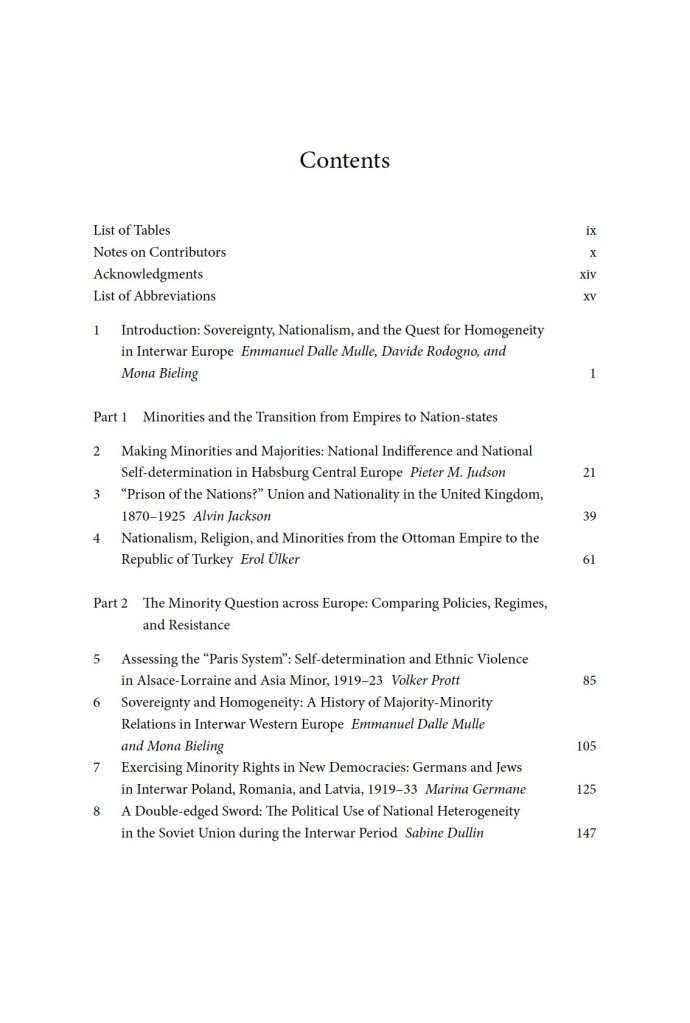
Were European empires ‘prisons of nations’? Did minority questions exist exclusively in eastern Europe during the interwar years? How did ordinary people in minority regions navigate conflicting forms of national identification? How did minority representatives mobilise support for minority rights transnationally? In fourteen chapters, Sovereignty, Nationalism and the Quest for Homogeneity in Interwar Europe answers these and other questions.
Proposing an unusual juxtaposition, the first part of the volume examines three empires (Austria-Hungary, the United Kingdom, and the Ottoman Empire) that, although on different scales, experienced crisis and partition at the end of the Great War. Pieter Judson shows how imperial forms of governance in the Austrian part of the Habsburg Empire gave more space to people to speak their preferred language and to embrace a wider array of self-understandings than the nation-states that followed. The United Kingdom is often examined as a nation-state rather than a union state. By contrast, Alvin Jackson considers it as a composite monarchy and dissects the centrifugal and centripetal forces that led to Britain’s partial break-up, but also to its survival after the First World War. Erol Ülker closes this first part of the volume by examining majority-minority relations in the Ottoman Empire from 1908 to 1923. He concludes that Turkish policies toward non-Turkish minorities were more complex and varied than recognised by traditional accounts.
The second part of the book studies comparatively minority policies in interwar Europe. It demonstrates that minority questions were debated throughout the continent and that the allegedly ‘civilised’ West did not treat minorities more liberally than the supposedly ‘backward’ East. Volker Prott compares violence in Alsace-Lorraine and Asia Minor. He highlights how a temptation to coercively homogenise populations was inherent in the post-war international order, but also identifies factors that restrained large-scale violence. Then, Mona and Emmanuel consider Belgium, Italy, and Spain as nationalising states. They show how these countries adopted homogenising policies with varying degrees of coercion and thus debunk some lingering myths of populations’ homogeneity in interwar western Europe. Marina Germane examines minority policies and mobilisation in Latvia, Poland, and Romania. Following German and Jewish representatives, she investigates the limits of domestic mobilisation and how disillusion pushed activists to move their activities from domestic arenas to the transnational sphere. In the last chapter of this part of the book, Sabine Dullin dissects the USSR’s double-edged nationality policy. She argues that the Soviets promoted national cultures throughout the Union, but also saw minorities as dangerous fifth columns and targets of collective punishment and forced displacement.
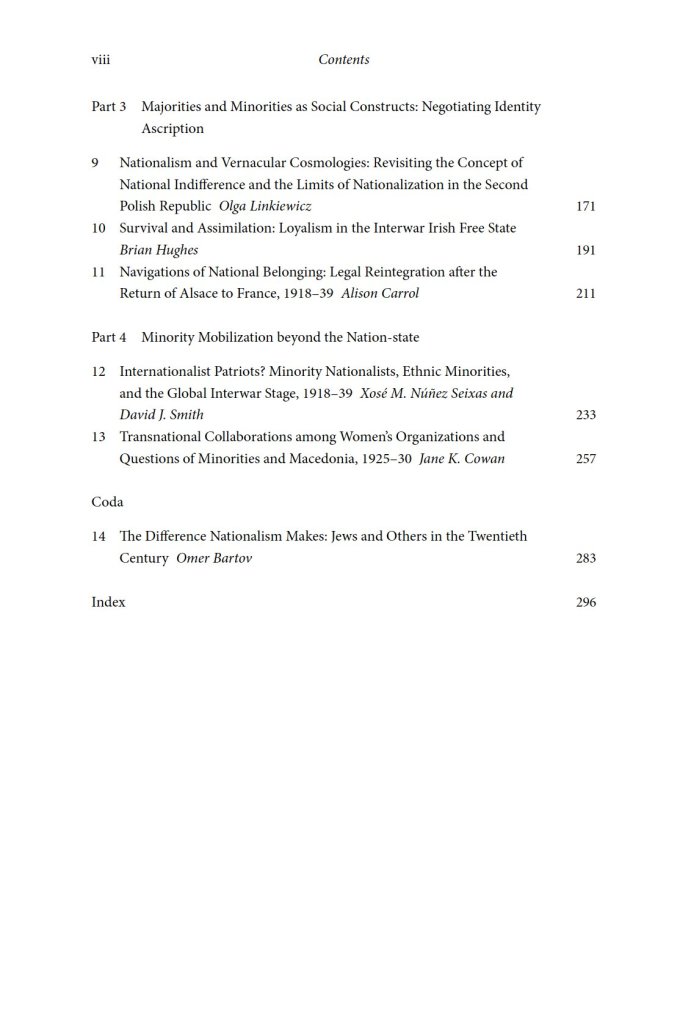
Part three of the book examines from the bottom-up processes of identification in different European contexts. It builds upon, but also challenges the national indifference framework. The chapter in this part emphasise how the space for indifference shrank in an increasingly nationalising interwar Europe. Olga Linkiewicz zooms in on rural conflicts in eastern Poland during the 1924 language plebiscite. She shows how peasants behaved in accordance with the principles of a vernacular cosmology that defies easy categorisation as either national indifference or full Polish nationalisation. Brian Hughes explores strategies of everyday resistance among loyalists during and after the Irish Revolution. He dissects the meaning of loyalism, as well as dynamics of integration and assimilation within an increasingly Catholic and Gaelic Irish Republic. Alison Carrol closes this part of the book revisiting Alsace’s return to France. She explores how different groups within Alsatian society pushed the state to adopt flexible policies of integration that created unexpected spaces for alternative understandings of identity.
Part four of the volume follows minority representatives across borders and gauges their efforts to lobby foreign governments, international organisations and the broader international community in favour of the defence of minority rights. Xosé Manoel Nuñez Seixas and David Smith map transnational networks of minority rights advocacy across Europe. They identify the emergence of a transnational nationality theory that, despite its failure, constituted an alternative to the model of the homogenous nation-state in interwar Europe. Jane Cowan explores the triangular, asymmetric and non-reciprocal relation between the Women’s International League for Peace and Freedom (WILPF), Bulgarian and Macedonian female activists and the male-dominated League of Nations. She shows how, in their interactions, these actors navigated hierarchies of gender, class, race, and civilisation.
Omer Bartov closes the book with a broad-ranging coda on the ‘conundrum of national indifference’. National indifference, he argues, rightly reminds us to be sceptical of the arguments of nationalist zealots. The history of the 20th century, as well as the recent Russian aggression of Ukraine, equally reminds us that we downplay the power of nationalism at our own peril. As Bartov and many other contributors suggest, although nationhood was not the only form of identification in interwar Europe, or the most important, the space for indifference shrank considerably between the two World Wars, in Poland and Romania, but also in Italy, France and Ireland.
The Myth of Homogeneity at the Po-His Seminar in Antwerp
Interwar European debates about national conflicts and the preservation of peace were awash with discussions about minority questions and the threat that their mismanagement posed to the preservation of the international order established in Paris. Does that justify treating majorities and minorities as homogenous entities in conflict, or at least in tension, during this period? Although it is clear that at the level of elite discourses and state and international policy there were minority questions in interwar Europe, does this allow us to conclude that European populations were neatly divided into self-conscious majorities and minorities?
On 20 April Emmanuel discussed issues of nationalisation, national indifference and instrumental nationalism in Belgium, Italy and Spain at a session of the weekly seminar of the Power in History (Po-His) research centre at the University of Antwerp. The paper entitled Within Minorities: Repertoires of Instrumental Nationalism in Interwar Western Europe is a draft chapter of the monograph on minority questions in interwar western Europe that Emmanuel is currently writing. The chapter challenges the homogeneity of minority groups in Belgium, Italy and Spain. It explores fluid identities among the populations living in minority areas, often caught between the opposing injunctions of state authorities and minority organisations. The chapter stresses how the boundaries dividing minorities and majorities were unstable and in flux. However, it also shows that in the interwar period, the ‘space’ for indifference towards questions of nationhood and belonging progressively shrunk.
The chapter builds upon and simultaneously moves away from the national indifference framework that since the mid-2000s has dominated studies on nationalism from below. It relies on a conception of nationhood as a property distributed with different degrees of intensity among the individuals of a specific population. While some individuals hold nationhood at the very core of their priorities and have a principled commitment to defending the national cause, others take more instrumental positions on the matter, which favour flexible patterns of behaviour that prioritise alternative, or compatible, forms of identification. Following a distinction proposed by Brendan Karch, the chapter inquires into the chasm between ‘“instrumental” social attitudes towards the nation and “value-driven” nationalism’. Instrumentally-minded actors ‘balanced national loyalties against a field of other commitments and values’, while value-driven activists pursued their national goals ‘nearly regardless of the means necessary to achieve them’.
The chapter applies this framework to different contexts in interwar western Europe. It first looks at the years immediately after the First World War and gauges the degree of mobilisation of minority societies in the context of the so-called Wilsonian Moment, when transnational activists attempted to lobby the great powers and other actors at the Paris Peace Conference in favour of their region’s self-determination, while hoping to rallying the local population in these areas behind their cause. It then moves the gaze to the defence of education in minority language at the regional level in democratic Belgium, especially in the late 1920s and during the 1930s, and in liberal and republican Spain, i.e. before the dictatorship of Miguel Primo de Rivera (in 1923) and during the Second Republic (1931-1936). The chapter examines how ordinary people’s behaviour often frustrated nationalist activists, who wanted to expand the use of minority languages within the school system. Finally, the chapter focuses on the very different context of Mussolini’s dictatorship in Italy and attempts to elucidate how people deemed to belong to minority groups in South Tyrol and Venezia Giulia navigated daily life in the fascist dictatorship through strategies of acceptance, acquiescence, and even enthusiastic collaboration.
Despite the absence of a unique pattern of mobilisation, interwar western European minorities were hardly self-conscious homogenous entities. Even if in most areas cultural and linguistic differentiation from the national majority supposed to identify with and control the state provided potential for national mobilisation, this never automatically translated into political activism. Ordinary people still had room for navigating between competing and complementary self-understandings, related to and beyond nationhood. Yet utter indifference to nationhood became ever more difficult in the radicalised climate of the late 1930s.
The paper received in-depth feedback from the participants in the seminar and Emmanuel is now working on a new version.
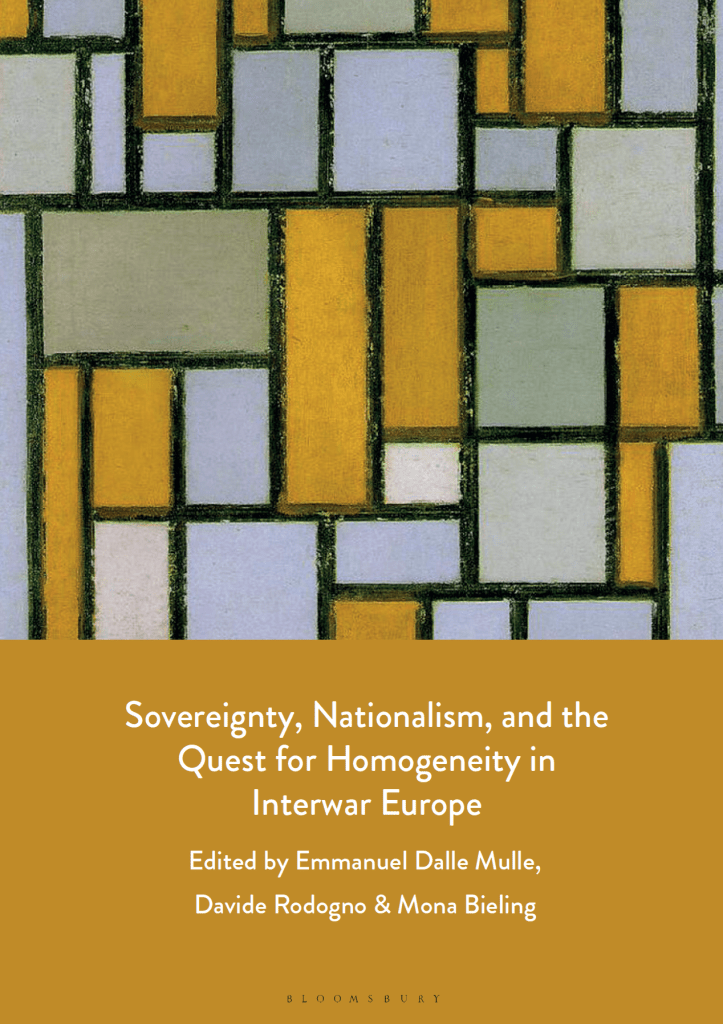
After about three years of work and a global pandemic, Sovereignty, Nationalism and the Quest for Homogeneity in Interwar Europe eventually goes to press. The edited volume will be released in print and electronic formats by Bloomsbury Academic on 18 May 2023 (click here for more info). The electronic version will be available in open access thanks to a grant from the Swiss National Science Foundation.
Through 14 chapters, the volume offers an in-depth, comparative and transnational study of minority questions in Europe focusing on, although not limiting itself to, the interwar period. The volume makes two major contributions to current historiographical debates on this topic. First, until now interwar European minority questions have been predominantly discussed in the context of eastern Europe. This volume challenges that geographical emphasis by examining both eastern and western European experiences. It thus lays the foundation for a new comparative international history of the relations between national majorities and minorities in Europe after the Great War. Second, building on the observation that nationalist conflicts are based on dynamic interactions between multiple actors, this book brings together different perspectives and methodological approaches (political, social, comparative and transnational) to provide a comprehensive account of minority questions between the two World Wars.
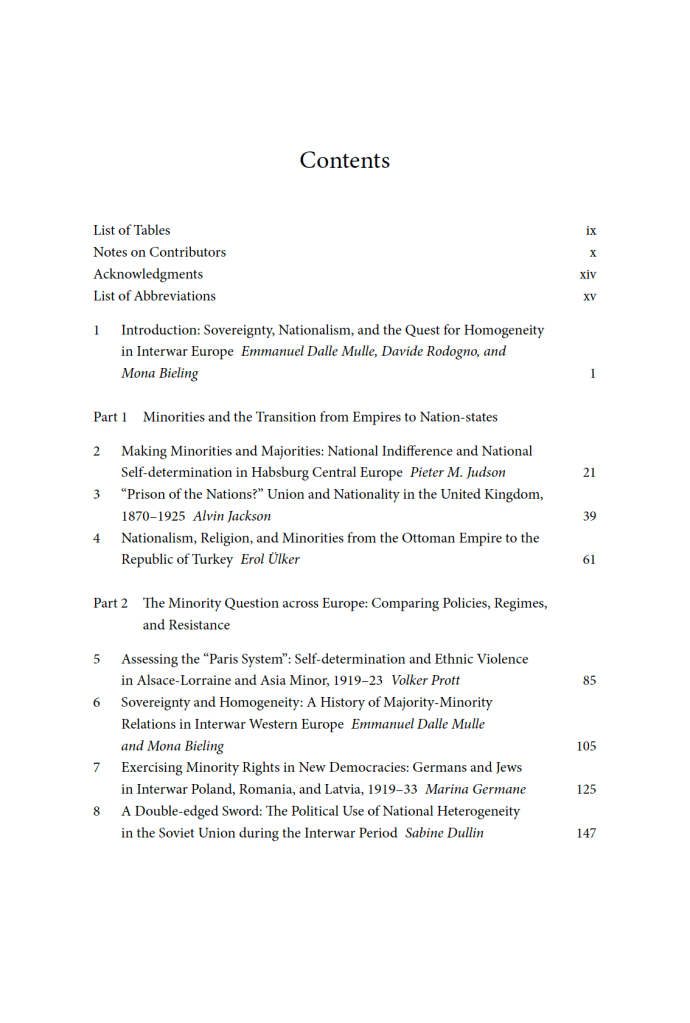
The volume is the result of a truly international collaboration featuring contributions from leading academics and emerging scholars based in Austria, Ireland, Poland, Spain, Switzerland, Turkey, the UK and the USA among others(see the table of contents below). We thank them all for their wonderful chapters.
The volume originated in the international workshop Sovereignty, Nationalism and Homogeneity in Europe between the Two World Wars that the Myth of Homogeneity team organised at the Geneva Graduate Institute in February 2020, right before the onset of the first wave of lockdowns outside China due to the global pandemic of covid-19. Some of the initial participants left, while others joined at a later stage. Among the many people that have taken part in this journey with us, we would like to remember Eric Weitz. Eric was supposed to write the conclusion of our volume with a chapter based on the memorable keynote that he gave at the end of our Geneva workshop in February 2020. Unfortunately, Eric left us in July 2021. The volume is dedicated to him.
The research behind this volume has been funded by the Swiss National Science Foundation (grant n. 169568) and the European Union’s Horizon 2020 research and innovation program under the Marie Skłodowska-Curie grant agreement no. 847635. The Pierre du Bois Foundation contributed to covering editing expenses. We thank them all for their generous support.
Our edited volume with Bloomsbury Academics has eventually gone into production
In September 2022, Bloomsbury Academics announced that the edited volume Sovereignty, Nationalism and the Quest for Homogeneity in Interwar Europe, which Emmanuel, Davide and Mona have been putting together for the last two years, has eventually gone into production and should be released in May 2023.
It has been a long and twisted journey, marked by the pandemic and other dramatic events, first of all the sudden demise of Eric Weitz, who was supposed to write the conclusion of the volume and to whom this will be dedicated. The Myth of Homogeneity team started working on it in March 2020, right after having held the workshop Sovereignty, Nationalism and Homogeneity in Europe between the World Wars, the last event before the first wave of lockdowns due to the Covid-19 pandemic began. The event was co-organised with the Albert Hirschman Centre on Democracy (more info on it in our podcast on the event here).
The volume bridges the East-West divide still existing in the historiography of minority questions in interwar Europe. It also puts together contributions examining majority-minority relations from different perspectives, notably comparative, bottom-up and transnational. It includes discussions of: the transition from empires to nation-states with an innovative comparison of traditional cases of imperial breakdown, such as the Ottoman and Habsburg empires, with the United Kingdom, usually considered in this context as a nation-state rather than a composite monarchy; the Paris system and how the new international order inaugurated in the French capital extended its influence over the entire continent causing quests for national homogeneity in different European regions; the concept of national indifference, its applicability to the interwar years and its alternatives; and the transnational organisations and networks of activists that defended minority rights, either directly, as in the case of the Congress of European Nationalities, or as part of a broader concern for peace and international collaboration, as in the case of the Women’s International League for Peace and Freedom.
Through 14 chapters and thanks to an outstanding line-up of authors (see below for the full list), the volume fills an important gap in the historiography of the interwar years, touching upon a wide range of topics such as the history of nationalism, internationalism, minority questions, human rights, activism and gender.
The volume features contributions from: Omer Bartov, Mona Bieling, Alison Carrol, Jane K. Cowan, Emmanuel Dalle Mulle, Sabine Dullin, Marina Germane, Brian Hughes, Alvin Jackson, Pieter M. Judson, Olga Linkiewicz, Xosé M. Núñez Seixas, Volker Prott, Davide Rodogno, David J. Smith and Erol Ülker.
On 27-28 February 2020 we organised a workshop on Sovereignty, Nationalism and Homogeneity in Europe between the Two World Wars.
For a day and a half, 18 scholars specialised in different aspects of late 19th and early 20th century European history met at the Graduate Institute Geneva to discuss intergroup relations and, more specifically, minority issues in interwar Europe. The papers presented at the event showcased the complexity of minority questions by using different approaches often emphasising varied aspects of majority-minority relations. While some participants examined majority-minority relations in different European countries from a broad comparative perspective, others looked more closely at specific cases or questioned the appropriateness of using the categories of majority and minority to refer to such groups. Others yet followed minority representatives and other individuals concerned with minority questions across borders and into interwar organisations and networks of activism.
A group picture of the participants taken on the morning of the second day.
The overall result was a rich exchange that highlighted how after Versailles, regardless of whether they lay in the ‘civilised West’ or the still ‘backward East’ (to quote some stereotypical views hegemonic at the time), European states tended to fit the populations living within their borders into neat ethno-cultural categories and, although to different degrees, promoted homogeneity through a wide range of nation-building strategies. Minority representatives and organisations vocally denounced violations of minority rights and fought for better protection of their cultural peculiarities, but, at the same time, often exaggerated the importance of group identity for the wider populations they claimed to speak for and the homogeneity of minorities themselves. At times, ordinary people followed the injunction of minority representatives; sometimes, however, they showed signs of ‘national indifference’ and based their behaviour on considerations and interests not directly linked to their purported national identity—of which in many cases they were not even aware. The rich, and sometimes contradictory, tapestry of perspectives stemming from the different panels highlighted the need for a multi-dimensional approach to interwar intergroup relations; one taking into account different actors, contexts and motivations for action.
Eric Weitz’ lecture on “The Global Struggle for Human Rights in the Age of Nation-States”.
In the evening of the first day, Eric Weitz, Distinguished Professor of History at City College and the Graduate Centre of the City University of New York, broadened the thematic contours of our workshop by presenting his wide-ranging new book, A World Divided: The Global Struggle for Human Rights in the Age of Nation-States. In the talk, Professor Weitz explored the relationship between nation-states, human rights and minority rights in the context of the ’emergence’ of minorities between the late 19th and early 20th century as well as during the process of decolonisation in Africa.
Apart from advocating the ‘multi-dimensional’ approach mentioned above, the workshop also contributed to bridging the East-West divide currently existing in the literature, whereby minority issues are still implicitly considered as a ‘Question of Eastern Europe’ (to quote the title of a famous interwar work on the subject) while the international history of majority-minority conflicts in Western Europe remains in its infancy.
The Myth of Homogeneity Team would like to thank the Swiss National Science Foundation, the Pierre du Bois Foundation, the Graduate Institute and the Albert Hirschman Centre on Democracy for their kind support as well as all the participants for their insightful contributions.
Below you can listen to the paper given at the workshop by our team members, Emmanuel and Mona, entitled Sovereignty and Homogeneity: A History of Majority-Minority Relations in Interwar Western Europe.
The Myth of Homogeneity Workshop, IHEID Geneva, 27-28 February 2020
The years around the Great War were crucial for both nationalism and democracy. While at Versailles national self-determination was branded as the main principle to be followed in the resolution of territorial conflicts, domestically, several European states introduced universal suffrage or considerably lowered property requirements thus entering the age of mass politics. In such a context of rising nationalism and expanding democracy (although often fragile democracy), majority-minority relations acquired an unprecedented relevance.
The aim of this workshop is to bring together historians with different geographical expertise and using varied approaches to draw the main lines of a European comparative and transnational history of relations between national majorities and minorities during the interwar years. The workshop will explore the nexus between popular sovereignty and cultural homogeneity, inquire into why minorities became a ‘problem’ after the Great War, examine minority issues within and across state borders, and question the strength of national allegiances among ordinary people.









 The Myth of Homogeneity