The MoH team goes more in depth into the Vatican’s approach to Western European minority questions
For many European minorities, churches were a safe heaven in the interwar period. In the most repressed areas, religious instruction and service in the mother tongue of minority populations were the only moments when members of such groups could freely speak and study their language. Yet the duality of the Church, as an institution devoted to the spiritual care of its worshippers, and the Vatican, as a state with diplomatic relations with other states, considerably blurs any simple portrayal of the Catholic Church’s role in promoting the defence, or the repression, of minority rights. The most surprising aspect, however, is that until now the Church has been remarkably absent in major works on the interwar minority question.
In order to fill this gap, Emmanuel had already spent two weeks at the Vatican Apostolic Archive in April 2022. Back then, he had found substantial material showing a rift within the Catholic hierarchy. On the one hand, there was the lower clergy on the ground in minority regions, which was often in favour of supporting the linguistic rights of local populations and ensure that religious service and instruction be given in the vernacular language (as prescribed by the religious doctrine). On the other, one could find the higher echelons of the Church, which were more responsive to the diplomatic pressures exercised by ‘nationalising states’ determined to enforce linguistic homogeneity and thus saw priests who defended minority languages as dangerous nationalists and irredentists.
In 2022, however, Emmanuel did not have sufficient time to consult also the documents of the Archives of the Vatican State Secretariat. This contains the internal communications of the State Secretariat (the equivalent of a Ministry of Foreign Affairs), while the Apostolic Archive contains the correspondence with the Nuncios (the equivalent of state diplomats abroad). These documents will contribute to shed light on the internal rift within the Church, especially in the context of the radicalising 1930s, when the rise of Nazism, the outbreak of the Spanish civil war, the 1939 Option agreement in Italy and the development of extreme-right nationalist forces in Flanders and Eupen-Malmedy increased the salience of issues revolving around nationhood and belonging.
The material gathered during the next two weeks will form a cornerstone of the last chapter of Emmanuel’s new monograph The Myth of Homogeneity: Minority Questions in Interwar Western Europe and will hopefully provide sources for further academic articles.
A new publication by the MoH Teamon the Nationalities Papers
Think of the immediate post-First World War period and the Paris Peace Conference will immediately come to mind. German reparations, disarmament and the League of Nations will probably ensue. Some of you would probably have heard of minorities, notably as a ‘problem’ in the eastern part of Europe that the Conference and the following League tried to solve. Most of these minorities, a few would also point out, were made of people who identified as Germans. Yet, very few of you would add that German minorities existed also in western Europe, notably in Belgium, France and Italy, which, at the end of the Great War, annexed territories with sizable German-speaking populations.
A paper written by Emmanuel, Alessandro and Volker Prott (from Aston University Birmingham), which has just been published in The Nationalities Papers, examines precisely this topic in a comparative perspective. The paper points out that in most accounts of peacemaking after the First World War, ‘flawed’ decisions at ‘Versailles’ caused the ethnically mixed states of central and eastern Europe to descend into violent ethnic clashes, while the allegedly more homogenous western European states faced few issues with minorities.
This article challenges such simplistic view by examining the treatment of German-speaking minorities in the borderlands of Alsace-Lorraine, South Tyrol, and Eupen-Malmedy in the immediate post-war and the early interwar period. Building on an innovative comparative framework of five key variables, the article finds that, in all three cases, post-war borders generated incentives for the respective governments to suppress their new minorities, and that states used ethnic markers to target them. However, the strength of state institutions and liberal principles account for a reversal (Alsace-Lorraine), moderation (Eupen-Malmedy), or hardening (South Tyrol) of measures. Furthermore, international commitment to defend the new borders and the absence of a tradition of ethnic violence also had a significant impact.
The paper is available in First View version at https://doi.org/10.1017/nps.2024.24 and should appear in print later this year or at the beginning of 2025.
A new publication and a new conference presentation by the MoH Team
Many people know the Spanish north-western city of Girona for one of three things: it has offered some of its breathtaking corners to the famous TV series Game of Thrones; it is home to former Catalan President Carles Puigdemont (who has been living in Belgium since the 2017 attempt of his government to convert Catalonia into an independent country); and, in the late 2000s, Ryanair turned its airport into the main gateway to the Costa Brava.
On 2-3 November 2023, the city also became the venue of an international conference on the topic of Global Wilsonism and its Impact on Europe and America. The event gathered about 15 researchers working on different aspects of the so-called Wilsonian Moment, that is a moment between the end of 1918 and the first half of 1919, when President Woodrow Wilson briefly turned into a symbol of peace, justice and self-determination around the world.
In this context, Emmanuel presented a paper written with Mona and entitled Autonomy over Independence: Self-Determination in Catalonia, Flanders, and South Tyrol in the Aftermath of the Great War. The paper argues that, while the impact of the postwar spread of self-determination on the redrawing of eastern European borders and on the claims of colonial independence movements has been extensively researched, the international historiography has paid little attention to minority nationalist movements in western Europe. The text thus focuses on three regions (Catalonia, Flanders and South Tyrol) that experienced considerable sub-state national mobilisation in the interwar period and aims to understand whether the leaders of western European minorities and stateless nations shared the same enthusiasm as their anti-colonial and eastern European counterparts for the new international order that self-determination seemed to foreshadow in the months following the end of the First World War.
The article concludes that nationalist forces in Catalonia, Flanders and South Tyrol initially mobilised self-determination and referred to Wilson as a symbol of national liberation, but this instrumentalisation of self-determination was not sustained. Large-scale mobilisation occurred only in Catalonia, and, even there, it disappeared suddenly in spring 1919. Furthermore, sub-state nationalist movements in western Europe tended to mobilise self-determination to gain regional autonomy, rather than full independence. The willingness of these movements to privilege autonomy over full independence made them more receptive to compromise. Radical forces would become stronger only in the 1930s and largely for reasons not directly connected to the post-war mobilization around self-determination.
The presentation shortly followed the publication of the paper in issue 53(4) of European History Quarterly in October 2023. The paper is available in open access at the journal’s website: https://journals.sagepub.com/doi/full/10.1177/02656914231198182
The volume is available in hardback and in open access online
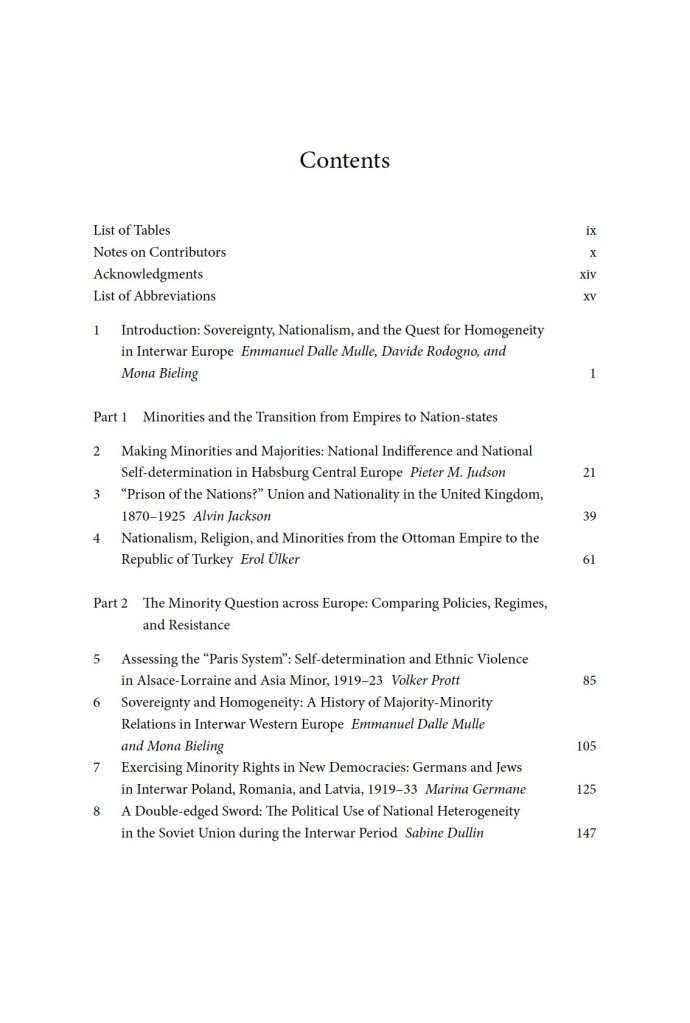
Were European empires ‘prisons of nations’? Did minority questions exist exclusively in eastern Europe during the interwar years? How did ordinary people in minority regions navigate conflicting forms of national identification? How did minority representatives mobilise support for minority rights transnationally? In fourteen chapters, Sovereignty, Nationalism and the Quest for Homogeneity in Interwar Europe answers these and other questions.
Proposing an unusual juxtaposition, the first part of the volume examines three empires (Austria-Hungary, the United Kingdom, and the Ottoman Empire) that, although on different scales, experienced crisis and partition at the end of the Great War. Pieter Judson shows how imperial forms of governance in the Austrian part of the Habsburg Empire gave more space to people to speak their preferred language and to embrace a wider array of self-understandings than the nation-states that followed. The United Kingdom is often examined as a nation-state rather than a union state. By contrast, Alvin Jackson considers it as a composite monarchy and dissects the centrifugal and centripetal forces that led to Britain’s partial break-up, but also to its survival after the First World War. Erol Ülker closes this first part of the volume by examining majority-minority relations in the Ottoman Empire from 1908 to 1923. He concludes that Turkish policies toward non-Turkish minorities were more complex and varied than recognised by traditional accounts.
The second part of the book studies comparatively minority policies in interwar Europe. It demonstrates that minority questions were debated throughout the continent and that the allegedly ‘civilised’ West did not treat minorities more liberally than the supposedly ‘backward’ East. Volker Prott compares violence in Alsace-Lorraine and Asia Minor. He highlights how a temptation to coercively homogenise populations was inherent in the post-war international order, but also identifies factors that restrained large-scale violence. Then, Mona and Emmanuel consider Belgium, Italy, and Spain as nationalising states. They show how these countries adopted homogenising policies with varying degrees of coercion and thus debunk some lingering myths of populations’ homogeneity in interwar western Europe. Marina Germane examines minority policies and mobilisation in Latvia, Poland, and Romania. Following German and Jewish representatives, she investigates the limits of domestic mobilisation and how disillusion pushed activists to move their activities from domestic arenas to the transnational sphere. In the last chapter of this part of the book, Sabine Dullin dissects the USSR’s double-edged nationality policy. She argues that the Soviets promoted national cultures throughout the Union, but also saw minorities as dangerous fifth columns and targets of collective punishment and forced displacement.
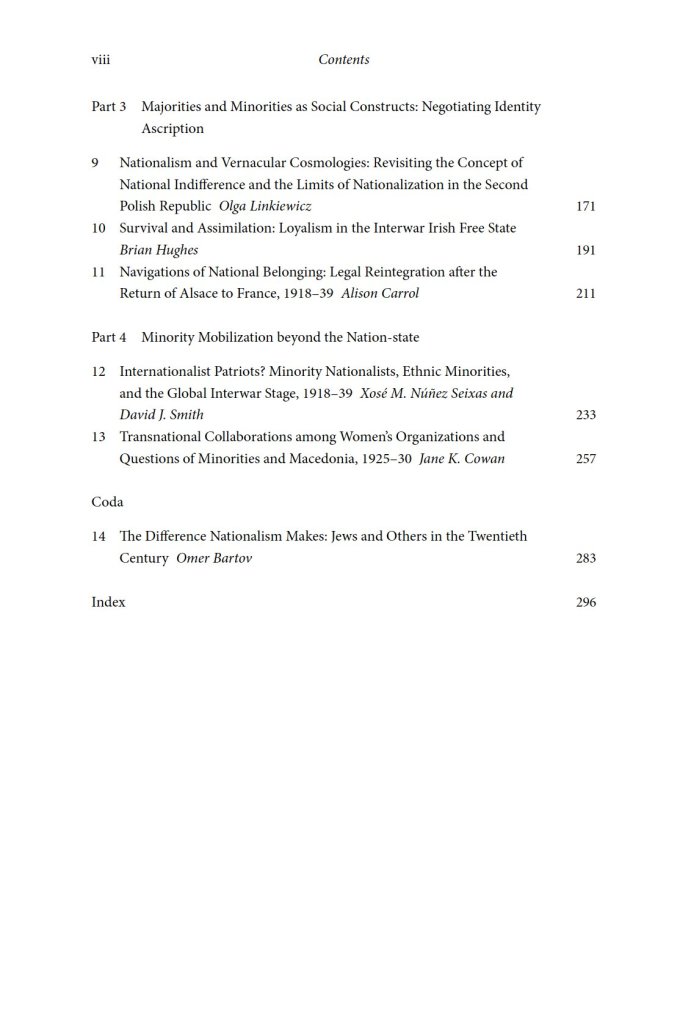
Part three of the book examines from the bottom-up processes of identification in different European contexts. It builds upon, but also challenges the national indifference framework. The chapter in this part emphasise how the space for indifference shrank in an increasingly nationalising interwar Europe. Olga Linkiewicz zooms in on rural conflicts in eastern Poland during the 1924 language plebiscite. She shows how peasants behaved in accordance with the principles of a vernacular cosmology that defies easy categorisation as either national indifference or full Polish nationalisation. Brian Hughes explores strategies of everyday resistance among loyalists during and after the Irish Revolution. He dissects the meaning of loyalism, as well as dynamics of integration and assimilation within an increasingly Catholic and Gaelic Irish Republic. Alison Carrol closes this part of the book revisiting Alsace’s return to France. She explores how different groups within Alsatian society pushed the state to adopt flexible policies of integration that created unexpected spaces for alternative understandings of identity.
Part four of the volume follows minority representatives across borders and gauges their efforts to lobby foreign governments, international organisations and the broader international community in favour of the defence of minority rights. Xosé Manoel Nuñez Seixas and David Smith map transnational networks of minority rights advocacy across Europe. They identify the emergence of a transnational nationality theory that, despite its failure, constituted an alternative to the model of the homogenous nation-state in interwar Europe. Jane Cowan explores the triangular, asymmetric and non-reciprocal relation between the Women’s International League for Peace and Freedom (WILPF), Bulgarian and Macedonian female activists and the male-dominated League of Nations. She shows how, in their interactions, these actors navigated hierarchies of gender, class, race, and civilisation.
Omer Bartov closes the book with a broad-ranging coda on the ‘conundrum of national indifference’. National indifference, he argues, rightly reminds us to be sceptical of the arguments of nationalist zealots. The history of the 20th century, as well as the recent Russian aggression of Ukraine, equally reminds us that we downplay the power of nationalism at our own peril. As Bartov and many other contributors suggest, although nationhood was not the only form of identification in interwar Europe, or the most important, the space for indifference shrank considerably between the two World Wars, in Poland and Romania, but also in Italy, France and Ireland.
An article of the MoH Team in The Historical Journal
Source: Christoph von Hartungen, Fabrizio Miori, and Tiziano Rosani, eds., Le lettere aperte 1939–1943: L’Alto Adige delle opzioni (2 vols., Bolzano, 2006).
You have probably never heard of the 1939 Option Agreement between fascist Italy and Nazi Germany. Yet the agreement was the first population transfer agreement in western Europe. Emmanuel and Alessandro have decided to take a new look at this neglected event of interwar European history from the perspective of how the fascist regime conceived minorities and their assimilation in Italy.
Studying the 1939 Option Agreement offers a unique opportunity to shift the focus of the historiography on interwar minority questions from eastern to western Europe, thus challenging the lingering view of eastern Europe as a land of endemic ethnic heterogeneity and conflict. Furthermore, the 1939 Option illuminates a form of ‘consistent ambivalence’ that problematises dominant analytical frameworks concerning the management of ethnic differences. Indeed, Italian fascists consistently affirmed the inevitable assimilation, and therefore inclusion, of minorities within the Italian nation. At the same time, they also deeply distrusted the allogeni (the fascist term to refer to people considered as Italian citizens of non-Italian ethnic origin). This ambivalent attitude reached a climax in the 1939 Option. Hence in order to understand fascist behaviour during the implementation of the agreement, Emmanuel and Alessandro argues that we need to consider the longer history of fascist attempts to homogenise the new provinces since the onset of the dictatorship.
Three features structured these attempts: a belief that the assimilation of these minorities would be inevitable; the absence of means to carry out radical solutions; and a deep-seated distrust of the minorities. Fascist policy during the Option was simultaneously more ambivalent than the current historiography suggests and more consistent with the regime’s interwar homogenisation policies. The fascists, in wanting to include the populations living in South Tyrol and Venezia Giulia, believed that the minorities’ assimilation to the Italian nation was inevitable. However, the regime could not fully overcome its deeply rooted mistrust of the allogeni. Whereas assimilation was the declared and desired goal of Italian authorities, their distrust of the minorities living in the new provinces placed the latter in a liminal state of simultaneous forceful inclusion and latent segregation. Despite being coerced to adopt the cultural script of the majority, the allogeni were marginalised in a way that finds little echo in existing analytical frameworks on the management of ethnic differences.
Although the regime was not monolithic and there were disagreements between fascist officers about the approach to follow in South Tyrol and Venezia Giulia, the consistent ambivalence examined in this article reveals a patterned behaviour that was prevalent throughout the interwar period. In broader terms, the article challenges the traditional eastern European focus of the literature on the League of Nations, self-determination, and the rise of minority questions after the First World War. It shows that state authorities in the supposedly homogeneous and ‘civilised’ West did face minority questions and adopted harsh homogenising policies that, however, did not produce the expected results.
The Myth of Homogeneity at the Po-His Seminar in Antwerp
Interwar European debates about national conflicts and the preservation of peace were awash with discussions about minority questions and the threat that their mismanagement posed to the preservation of the international order established in Paris. Does that justify treating majorities and minorities as homogenous entities in conflict, or at least in tension, during this period? Although it is clear that at the level of elite discourses and state and international policy there were minority questions in interwar Europe, does this allow us to conclude that European populations were neatly divided into self-conscious majorities and minorities?
On 20 April Emmanuel discussed issues of nationalisation, national indifference and instrumental nationalism in Belgium, Italy and Spain at a session of the weekly seminar of the Power in History (Po-His) research centre at the University of Antwerp. The paper entitled Within Minorities: Repertoires of Instrumental Nationalism in Interwar Western Europe is a draft chapter of the monograph on minority questions in interwar western Europe that Emmanuel is currently writing. The chapter challenges the homogeneity of minority groups in Belgium, Italy and Spain. It explores fluid identities among the populations living in minority areas, often caught between the opposing injunctions of state authorities and minority organisations. The chapter stresses how the boundaries dividing minorities and majorities were unstable and in flux. However, it also shows that in the interwar period, the ‘space’ for indifference towards questions of nationhood and belonging progressively shrunk.
The chapter builds upon and simultaneously moves away from the national indifference framework that since the mid-2000s has dominated studies on nationalism from below. It relies on a conception of nationhood as a property distributed with different degrees of intensity among the individuals of a specific population. While some individuals hold nationhood at the very core of their priorities and have a principled commitment to defending the national cause, others take more instrumental positions on the matter, which favour flexible patterns of behaviour that prioritise alternative, or compatible, forms of identification. Following a distinction proposed by Brendan Karch, the chapter inquires into the chasm between ‘“instrumental” social attitudes towards the nation and “value-driven” nationalism’. Instrumentally-minded actors ‘balanced national loyalties against a field of other commitments and values’, while value-driven activists pursued their national goals ‘nearly regardless of the means necessary to achieve them’.
The chapter applies this framework to different contexts in interwar western Europe. It first looks at the years immediately after the First World War and gauges the degree of mobilisation of minority societies in the context of the so-called Wilsonian Moment, when transnational activists attempted to lobby the great powers and other actors at the Paris Peace Conference in favour of their region’s self-determination, while hoping to rallying the local population in these areas behind their cause. It then moves the gaze to the defence of education in minority language at the regional level in democratic Belgium, especially in the late 1920s and during the 1930s, and in liberal and republican Spain, i.e. before the dictatorship of Miguel Primo de Rivera (in 1923) and during the Second Republic (1931-1936). The chapter examines how ordinary people’s behaviour often frustrated nationalist activists, who wanted to expand the use of minority languages within the school system. Finally, the chapter focuses on the very different context of Mussolini’s dictatorship in Italy and attempts to elucidate how people deemed to belong to minority groups in South Tyrol and Venezia Giulia navigated daily life in the fascist dictatorship through strategies of acceptance, acquiescence, and even enthusiastic collaboration.
Despite the absence of a unique pattern of mobilisation, interwar western European minorities were hardly self-conscious homogenous entities. Even if in most areas cultural and linguistic differentiation from the national majority supposed to identify with and control the state provided potential for national mobilisation, this never automatically translated into political activism. Ordinary people still had room for navigating between competing and complementary self-understandings, related to and beyond nationhood. Yet utter indifference to nationhood became ever more difficult in the radicalised climate of the late 1930s.
The paper received in-depth feedback from the participants in the seminar and Emmanuel is now working on a new version.
On the anniversary of Mussolini’s seizure of power, Alessandro and Emmanuel discuss a century of inter-ethnic relations in the Italian borderlands
Vito Timmel, “L’incendio del Balkan” (1941, Rivoltella Museum, Trieste)
At the end of October 1922, King Vittorio Emanuele III offered Benito Mussolini the task to form a new executive. In the previous days, the fascists camicie nere had seized control of several towns in northern and central Italy and threatened the government led by the liberal Luigi Facta to move the assault to Rome if this did not cede power to the National Fascist Party. The details of these events are well-known and have been studied extensively. What is less known however is that at the beginning of October 1922, the fascists had used the same tactics to take over the northern Italian city of Bolzano in what some fascists later defined as a kind of general rehearsal for the planned occupation of the capital.
At first sight Bolzano was an outlier in the series of urban attacks carried out by the fascists in the early 1920s. Indeed the black shirts usually targeted municipalities led by Socialist administrations. By contrast, a coalition of Liberal and Catholics ruled Bolzano. Yet Bolzano was not a random choice. Most of the city’s inhabitants were German speakers and the city was the main urban centre of South Tyrol, a territory that Italy annexed at the end of the First World War along with the mostly Italian-speaking Trentino. South Tyrol was also overwhelmingly German-speaking and several local parties and organisations had repeatedly opposed annexation asking that the local population be given the opportunity to have a say about its future. Post-war Italian liberal governments had rejected these calls, but had guaranteed the preservation of Austro-Hungarian legislation in the area, promised to respect minority rights and begun negotiations for regional autonomy. To the Fascist Party this sounded like a betrayal of the sacrifice of the Italian soldiers who had died in order to conquer an area that – the fascists believed – was ‘inherently’ Italian and had been Germanised by the Habsburg Empire. The March on Bolzano was an attempt to force the Italianisation of the city, as well as a test of the liberal elite’s commitment to respecting minority rights.
Taking advantage of the 100th anniversary of both the March on Rome and Bolzano, in a recent paper published by the Pierre du Bois Foundation for Current History, Alessandro and Emmanuel discuss fascist policies in the new provinces annexed at the end of the Great War – South Tyrol as well as Venezia Giulia – and the impact of the fascist attempts to Italianise the populations living in these borderlands on the rest of the 20th century, most notably on relations with the neighbouring countries of Austria and Yugoslavia (today Slovenia), as well as with Germany. The paper also examines the contradictions of the fascist approach to minorities. It argues that fascist thinking about the allogeni – the fascist term to identify Italians of non-Italian origins – and policy in South Tyrol and Venezia Giulia were informed by a form of ‘consistent ambivalence’ whereby fascists authorities were torn between the naif belief that the assimilation of the allogeni was inevitable and a deep-seated distrust of them, since they were deemed to be inherently disloyal citizens.
Yet 2022 marks another important anniversary: the 50 years since the signing of the second statute of autonomy of Trentino-South Tyrol which ushered in a period of stabilisation in majority-minority relations in the area. This statute of autonomy turned South Tyrol from a hotspot of nationalist conflict to an oft-cited success story of minority recognition and cross-border cooperation in Europe. To account for that, the paper goes beyond the interwar period and details the considerable, although hard-won, advances in minority rights and conflict management achieved in the second half of the 20th century.
The converging and diverging trajectories of Joan Estelrich and Josip Vilfan discussed at a Conference in Santiago de Compostela
On 9-10 June 2022, the research project La España global: identitades españolas en prospectiva transnacional organised a workshop at the University of Santiago de Compostela to discuss transnational historical research involving Spanish actors, identities and processes. The event allowed presenting results from the Myth of Homogeneity project about the transnational activities of minority representatives in interwar Europe. More specifically, Emmanuel examined the converging and diverging trajectories of the Catalan-Spanish nationalist leader Joan Estelrich and the Slovenian-Italian minority representative Josip Vilfan, both prominent members of the interwar Congress of European Nationalities, as a prism to reflect upon the entanglements between the study of minorities and transnational history.
At the core of the concept of transnationalism there is an idea of border crossing. More often than not, the border that is being crossed is that of the nation-state. Emmanuel’s presentation did engage with cross-border activities that challenged state jurisdictions, but also tried to extend the notion of transnationalism to the trespassing of regional and identity boundaries. Coming from countries beyond the remit of the minority protection system of the League of Nations and acting, for a considerable part of their lives, within repressive authoritarian regimes, Estelrich and Vifan eagerly engaged in transnational minority networks as a way to promote an internationalisation and reinforcement of interwar minority protection. In many ways, their story is one of successful collaboration. Yet, from the mid-1930s, their trajectories diverged considerably. While Vilfan remained a staunch supporter of transnational cooperation and of the work of the CEN, Estelrich drifted towards domestic engagement within the institutions of the Spanish Republic first, and transnational activity on Franco’s side later. However, despite their apparent glaring differences, both Estelrich and Vilfan had to confront similar painful dilemmas of collaboration and betrayal generated by their minority advocacy that forced them not only to cross state borders, but also to redefine the boundaries of their reference communities and severe previous bonds of loyalty.
Beyond the relevance of Estelrich’s and Vilfan’s transnational trajectories for the history of minority-majority relations in interwar Europe, the paper proposed two broader reflections on the nature of transnational history and the state of the current historiography that centred on questioning both the trans and the national in transnational. To be begin with the national, most of the historiography focuses on the national as the nation-state. Yet any scholar familiar with the nationalism studies literature knows that the nation and the nation-state never coincide. This is all the more glaring when it comes to minority populations who do not identify with the state they live in. Hence, the presentation proposed considering the everyday life of people identifying as national minorities within their state of citizenship as a transnational experience in and for itself, even if this everyday experience does not involve crossing the border of any nation-state. Concerning the trans, the paper explored, although still in very tentative form, the possibility that the crossing activity implied in this term might actually occur in the mind of historical actors, rather than in their physical whereabouts. In other words, examining the many identification dilemmas, twists and turns in Estelrich’s and Vilfan’s lives, the paper proposed to explore the concept of transnational interior processes. Stay tuned for future updates.
Emmanuel presented a paper co-authored with Alessandro entitled Victims of their own Rhetoric: The 1939 Option Agreement and the Consistent Ambivalence of Fascist Homogenisation Policy in the Italian New Provinces. The paper provides a re-reading of the 1939 Option Agreement between Italy and Germany in light of about two decades of fascist attempts at homogenising the border regions of South Tyrol and Venezia Giulia. It argues that although the behaviour of fascist authorities in the crucial months when 1939 drew to a close were ambivalent indeed, as many authors have already pointed out, that ambivalence was very much in line with the pattern followed by the regime throughout the interwar period. It thus concludes that such ‘consistent ambivalence’ was a key feature of fascist policy in the new provinces (as South Tyrol and Venezia Giulia were called at the time) and explains the bizarre behaviour of Italian officers in the second half of 1939.
As fascist Italy and Nazi Germany drew closer in the late 1930s, the Anschluss realised the Italian nightmare of a Greater Germany at its doors and Italian attempts to assimilate the population of South Tyrol continued to be disappointing (from the fascist perspective), finding a diplomatic solution to the question of South Tyrol grew ever more important. By mid-1939, the two countries came to an agreement whereby the population of the region would have to decide whether it wanted to remain in Italy or adopt German nationality and move north of the Brenner border. The Option Agreement, as it was called, was a strange hybrid between an option procedure, a plebiscite and a population transfer. It also created serious dilemmas for the two countries. Should they push for the transfer of all South Tyroleans or for as few as possible? The Nazi government needed men for the war effort. It was thus clearly in favour of a clean sweep solution. The Italian position was much more nuanced: while some were in favour of a total resettlement, many within the regime, especially at the local level were not. Furthermore, the Italian behaviour does not suggest a support for radical options. Nazi officers immediately began to spread propaganda in favour of resettlement (or to scare those South Tyroleans who wanted to stay, which actually were a majority). Italian authorities, in contrast, first remained silent. Then, when they realised that most people were inclined to vote for Germany, they tried to convince locals to stay. However, their propaganda was hampered by the strictures that their previous rhetoric and their fundamental distrust of the South Tyroleans imposed to their discourses.
The paper argues that this ambivalent approach was surprisingly consistent with fascist thinking about and treatment of Italy’s minorities. The ambivalence at the core of fascist policy in the new provinces stemmed from the combination of a naive belief that assimilation was inevitable – that the German-speakers of South Tyrol and the Slovenian and Croatian speakers of Venezia Giulia could not but assimilate to the great Italian civilisation – and a profound mistrust of the allogeni (as members of these two minorities were called at the time). Hence, the allogeni were simultaneously included by force in the Italian nation and marginalised in a liminal state of latent segregation.
The paper received positive comments and led to an interesting discussion about the differences between South Tyrol and Venezia Giulia, the precedent of the option procedure and the difficulties of co-writing an article.
H-Nationalism is proud to publish here the tenth post of its “Minorities in Contemporary and Historical Perspectives” series, which looks at majority-minority relations from a multi-disciplinary and diachronic angle. Today’s contribution, by Patrick Utz (University of Edinburgh), examines the fluid identities of German-speakers in South Tyrol in the 20th and 21st century.
South Tyrol or Alto Adige is Italy’s northernmost province. Mainly populated by German-speakers, the province became part of Italy after the breakup of Austria-Hungary in 1919. Today, far-reaching autonomous competencies and a mandatory power-sharing system includes both German and Italian-speakers. This has assured the peaceful cohabitation of the province’s diverse population. But while contemporary institutions are modelled around linguistic identities, South Tyrol has always been shaped by a multitude of overlapping and frequently ambiguous allegiances. Unpacking this complexity allows for important insights beyond South Tyrol: it sheds new light on how national minorities relate to culturally akin, neighbouring countries without raising fears of historical revanchism and irredentism.
Traditionalist regionalism
When South Tyrol became part of Italy, regional identities tended to be stronger than the linguistic-nationalist divisions that surfaced later in the twentieth century. Allegiances lay with the former Habsburg Crownland of Tyrol that included German-speakers and Italian-speakers between the river Inn in the North and the Lake Garda in the South. This identity built on Catholic conservativism and the collective memory of the resistance against Napoleonic troops in this mainly agrarian region. Clearly, these tenets were at odds with the liberal ideas that inspired the Risorgimento and shaped the Italian state into which South Tyrol was incorporated.
This alienation was not exclusive to the German-speaking minority that found itself in a new nation-state. It was shared by many Italian-speaking Tyroleans in what is now the Province of Trento. Indeed, Trento’s Catholic tradition would become influential within Italy’s powerful Christian democratic movement after 1945. Additionally, in the Austrian part of Tyrol, notions of the wider multilingual region never entirely faded. North Tyrol’s main university, for instance, has continued to offer Italian-language courses and hosts a faculty of Italian law.
By the middle of the twentieth century, however, increasingly aggressive forms of nationalism on both sides of the linguistic divide superseded patterns of pre-modern, regional identification.
Nationalist excesses and their remnants
National identities based on linguistic differences had taken shape over the course of the nineteenth century but were exacerbated with the rise of Nazism in Germany and Fascism in Italy. While the Italian Fascists aimed to forcefully assimilate German-speaking South Tyroleans, many among the latter hoped for South Tyrol to be incorporated into Hitler’s Reich. As part of their political rapprochement in the 1930s, the Italian and German regimes sought to resolve the issue of South Tyrol through population resettlement. German-speakers should decide whether they wanted to stay in South Tyrol, with the prospect of being forcefully assimilated; or whether they wanted to be resettled to the Reich. The plebiscite on resettlement deeply dived Italy’s German-speaking minority. The two sides accused each other of betraying their German national heritage or their Tyrolean homeland, respectively.
Large-scale resettlement never materialized amidst the devastation of the Second World War. Yet, the plans to do so revealed the deep-seated tension between those South Tyroleans who subscribed to German nationalism; and those, who maintained a regional identity where local allegiances trumped linguistic divisions.
After the Second World War, South Tyrol’s political elites aimed to reconcile these two camps within a common political structure for the whole German-speaking minority. This led to the creation of the South Tyrolean People’s Party (Südtiroler Volkspartei, SVP) in 1945. The SVP was highly successful in bringing together the different segments of the German-speaking minority and obtained over 90 percent of German-speakers’ votes. Yet, the defining characteristics of the minority remained contested. One wing considered the German-speaking South Tyroleans to be a linguistic-cultural group within the wider region of Tyrol that was now split between Austria and Italy. The other wing emphasized South Tyroleans’ membership within a larger German nation.
None of the resulting political aspirations put forth by either wing could feasibly be pursued in South Tyrol’s post-war environment. The aggressive nationalisms had irreversibly politicized the linguistic differences in South Tyrol. Thus, multilingual regionalism was no longer an option. At the same time, Western Europe’s emerging security structure solidified state borders and discredited all forms of pan-Germanism, which precluded the option of secession.
Re-interpreting regionalism
The SVP’s compromise was to demand autonomy for German-speakers within the Italian state, and a neat separation of South Tyrol’s language groups in public institutions. The reinstated Republic of Austria and the Austrian Tyrol were crucial in supporting this cause, despite Austria’s eagerness to differentiate itself from its own infamous German nationalist heritage.
The SVP and Austria’s negotiations with the Italian government succeeded in 1969. Since then, robust mechanisms for territorial autonomy and minority self-government have gradually been put in place. The autonomous institutions have substantially contributed to South Tyrol’s political stability and economic success. This has turned the institutions themselves into a reference point for collective identification. In 2014, more than 80 percent of German-speakers in the province identified as “South Tyroleans”. Allegiances with pan-Germanic and wider Tyrolean identities have markedly weakened.
At the same time, new forms of regionalism are allowing for a patchwork of identities that straddle linguistic and political borders. Oftentimes the resulting identities combine reinterpretations of historic elements with newly emerging allegiances. The SVP, for example, has become more vocal in portraying Austria as South Tyrol’s “motherland”. This stands in sharp contrast to the party’s previous commitments to the broader German cultural heritage. Simultaneously, the party promotes a “European Region of Tyrol” as part of the European Union’s cross-border initiatives. This embryonic entity resembles the historic Crownland of Tyrol and includes Italian and Germanic-dominated regions. Voters, too, have shown appetite for more political diversity. Votes still tend to be overwhelmingly cast to candidates from one’s own linguistic group. Yet, the once hegemonic conservative SVP now is in fierce competition with liberals, Greens and the populist right; with each challenger presenting their own vision of a South Tyrolean identity.
Conclusion
South Tyrol’s autonomous institutions may correctly be commended as “one of the most successful cases of consociational conflict regulation in the world”. The reasons for their success lie as much in their institutional design as they do in the complex and multi-layered identities of the province’s population. The nationalist excesses of the twentieth century have essentialized individual traits of these identities (in this case, language). However, the recognition of multiple, simultaneously held allegiances can dilute national antagonisms. The future success of South Tyrol’s institutions and of those with the aim to replicate its model depends on giving voice to this diversity.
Sources
Alber, Elisabeth, and Carolin Zwilling. “Continuity and Change in South Tyrol’s Ethnic Governance.” In Autonomy Arrangements around the World: A Collection of Well and Lesser Known Cases, edited by Levente Salat, Sergiu Constantin, Alexander Osipov and István Gergő Székely, 33-66. Cluj-Napoca: Editura Institutului pentru Studierea Problemelor Minorităţilor Naţionale, 2014.
Carlà, Andrea. “Peace in South Tyrol and the Limits of Consociationalism.” Nationalism and Ethnic Politics 24, no. 3 (2018): 251-75.
Grote, Georg. The South Tyrol Question, 1866–2010: From National Rage to Regional State. Oxford: Peter Lang, 2012.
Pallaver, Günther. “The Südtiroler Volkspartei: Success through Conflict, Failure through Consensus.” In Regionalist Parties in Western Europe: Dimensions of Success, edited by Oscar Mazzoleni and Sean Mueller, 107-34. New York: Routledge, 2016.
Steurer, Leopold. “Südtirol 1918-1945.” In Handbuch Zu Neueren Geschichte Tirols. Band 2: Zeitgeschichte. 1. Teil: Politische Geschichte, 179-312. Innsbruck: Universitätsverlag Wagner, 1993.
Patrick Utz is a PhD candidate in Politics at the University of Edinburgh. His research focusses on minority nationalism, irredentism and kin-state politics. It has been published in Nationalism and Ethnic Politics.
The Minorities in Contemporary and Historical Perspective series is organized by the Myth of Homogeneity Research Project at the Graduate Institute of International and Development Studies, Geneva, and the Centre on Constitutional Change at the University of Edinburgh.
For more information, please visit:
The Minorities in Contemporary and Historical Perspective series is organized by the Myth of Homogeneity Research Project at the Graduate Institute of International and Development Studies, Geneva, and the Centre on Constitutional Change at the University of Edinburgh.







 The Myth of Homogeneity