Emmanuel will spend two months and a half at the Centre for History
After Antwerp in 2023, the MoH Team lands in Paris. This time, Emmanuel will be spending two months and a half completing the drafting of his monograph The Myth of Homogeneity: Minority Questions in Interwar Western Europe at the Centre for History of Sciences Po Paris. The research stay will also allow him to access material at the Archive of Foreign Affairs in La Courneuve concerning the transition from the minority protection system of the League of Nations to the human rights regime of the United Nations, which will be at the core of the Epilogue of the book.
The Epilogue argues that the so-called transition to individual human rights in 1946-1948, in fact, marked the triumph of an assimilationist conception of human rights, one that did not really privilege the individual, but rather some specific groups (national majorities) and penalised other groups (national minorities). France was at the core of efforts within the UN to reject the inclusion of any clause concerning protection against assimilation in the Universal Declaration of Human Rights. France, along with the United States and many Latin American countries, defended the idea that states can legitimately go to great lengths to promote the homogenisation of its population. As the French delegate within the UN Commission on Human Rights said in 1948: ‘the historical development of France into a homogenous State has resulted from the extensive and rigorous application of universal human rights to all sections of the population’ (my emphasis). In this respect, the Epilogue will expand on an argument that Mona and Emmanuel have already explored in the following paper: https://themythofhomogeneity.org/2021/10/
This stay also offered Emmanuel the opportunity to attend the many activities organised by the Centre for History, as well as to discuss his research with some excellent scholars that work there, notably Sabine Dullin, Matthieu Fulla, Marc Lazar, Guillaume Piketty, Paul-André Rosental and Jakob Voegel.
A new publication by the MoH Teamon the Nationalities Papers
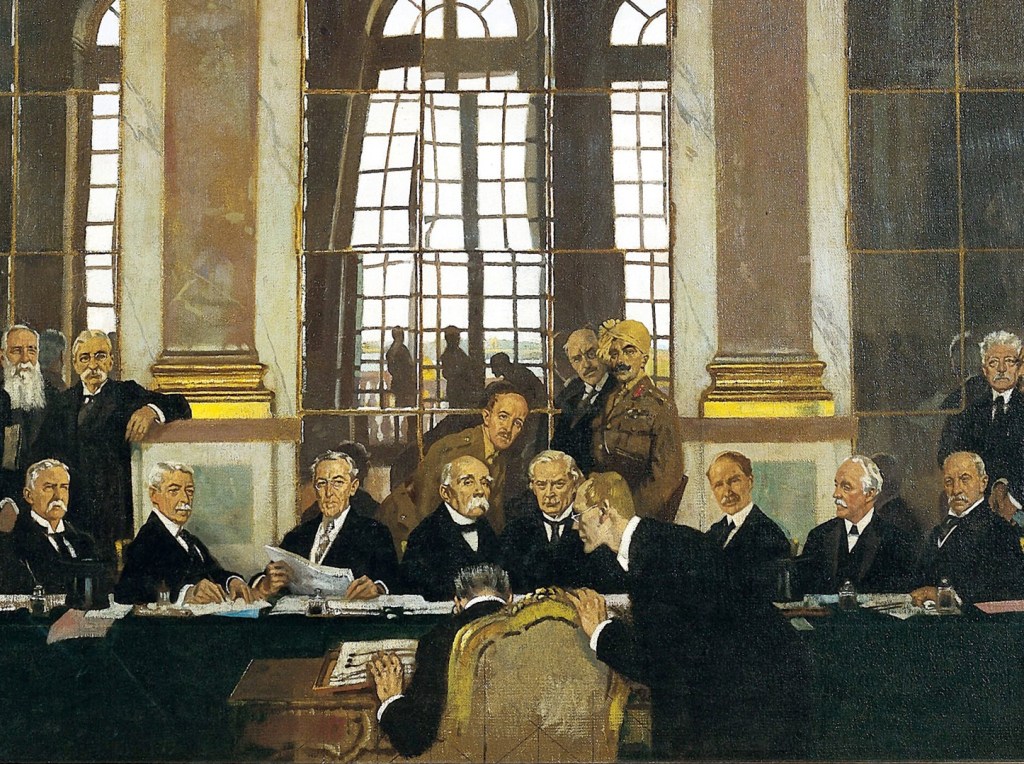
Think of the immediate post-First World War period and the Paris Peace Conference will immediately come to mind. German reparations, disarmament and the League of Nations will probably ensue. Some of you would probably have heard of minorities, notably as a ‘problem’ in the eastern part of Europe that the Conference and the following League tried to solve. Most of these minorities, a few would also point out, were made of people who identified as Germans. Yet, very few of you would add that German minorities existed also in western Europe, notably in Belgium, France and Italy, which, at the end of the Great War, annexed territories with sizable German-speaking populations.
A paper written by Emmanuel, Alessandro and Volker Prott (from Aston University Birmingham), which has just been published in The Nationalities Papers, examines precisely this topic in a comparative perspective. The paper points out that in most accounts of peacemaking after the First World War, ‘flawed’ decisions at ‘Versailles’ caused the ethnically mixed states of central and eastern Europe to descend into violent ethnic clashes, while the allegedly more homogenous western European states faced few issues with minorities.
This article challenges such simplistic view by examining the treatment of German-speaking minorities in the borderlands of Alsace-Lorraine, South Tyrol, and Eupen-Malmedy in the immediate post-war and the early interwar period. Building on an innovative comparative framework of five key variables, the article finds that, in all three cases, post-war borders generated incentives for the respective governments to suppress their new minorities, and that states used ethnic markers to target them. However, the strength of state institutions and liberal principles account for a reversal (Alsace-Lorraine), moderation (Eupen-Malmedy), or hardening (South Tyrol) of measures. Furthermore, international commitment to defend the new borders and the absence of a tradition of ethnic violence also had a significant impact.
The paper is available in First View version at https://doi.org/10.1017/nps.2024.24 and should appear in print later this year or at the beginning of 2025.
The volume is available in hardback and in open access online
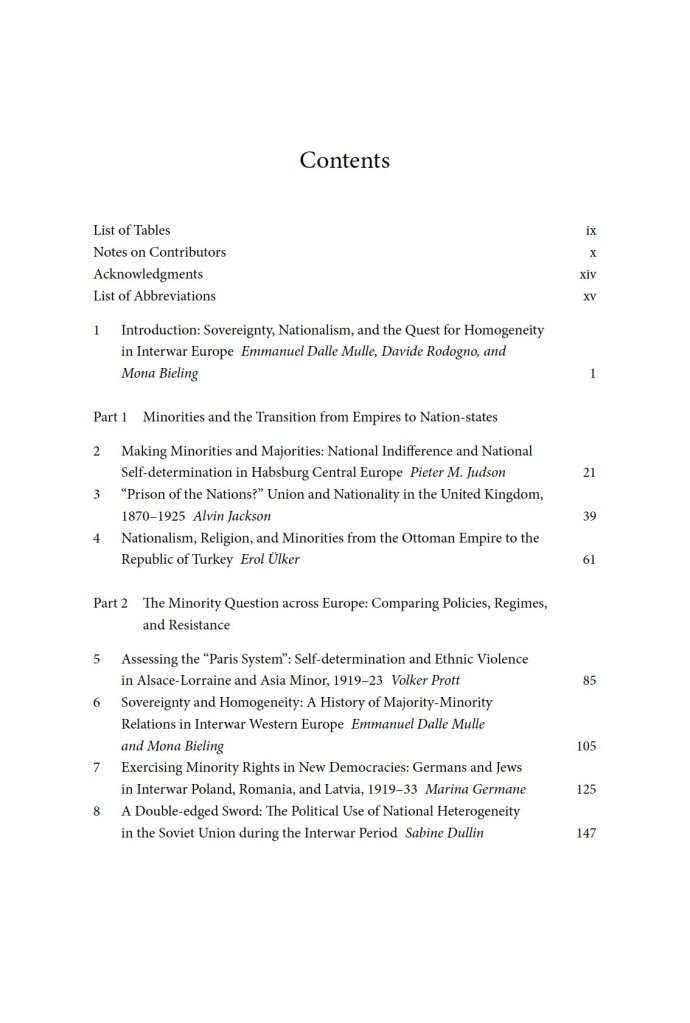
Were European empires ‘prisons of nations’? Did minority questions exist exclusively in eastern Europe during the interwar years? How did ordinary people in minority regions navigate conflicting forms of national identification? How did minority representatives mobilise support for minority rights transnationally? In fourteen chapters, Sovereignty, Nationalism and the Quest for Homogeneity in Interwar Europe answers these and other questions.
Proposing an unusual juxtaposition, the first part of the volume examines three empires (Austria-Hungary, the United Kingdom, and the Ottoman Empire) that, although on different scales, experienced crisis and partition at the end of the Great War. Pieter Judson shows how imperial forms of governance in the Austrian part of the Habsburg Empire gave more space to people to speak their preferred language and to embrace a wider array of self-understandings than the nation-states that followed. The United Kingdom is often examined as a nation-state rather than a union state. By contrast, Alvin Jackson considers it as a composite monarchy and dissects the centrifugal and centripetal forces that led to Britain’s partial break-up, but also to its survival after the First World War. Erol Ülker closes this first part of the volume by examining majority-minority relations in the Ottoman Empire from 1908 to 1923. He concludes that Turkish policies toward non-Turkish minorities were more complex and varied than recognised by traditional accounts.
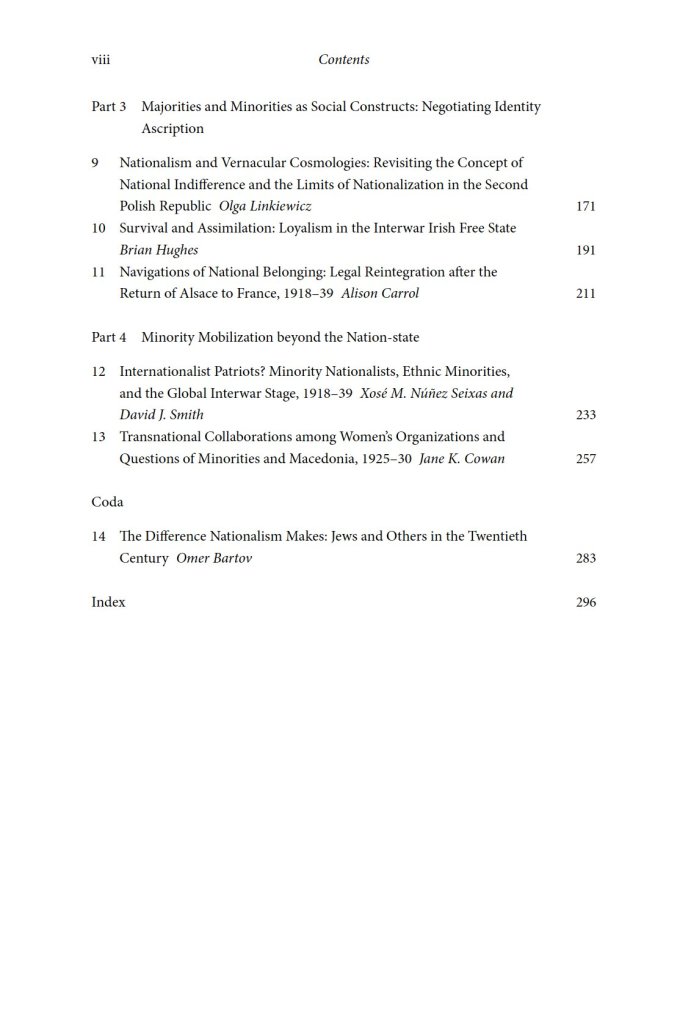
The second part of the book studies comparatively minority policies in interwar Europe. It demonstrates that minority questions were debated throughout the continent and that the allegedly ‘civilised’ West did not treat minorities more liberally than the supposedly ‘backward’ East. Volker Prott compares violence in Alsace-Lorraine and Asia Minor. He highlights how a temptation to coercively homogenise populations was inherent in the post-war international order, but also identifies factors that restrained large-scale violence. Then, Mona and Emmanuel consider Belgium, Italy, and Spain as nationalising states. They show how these countries adopted homogenising policies with varying degrees of coercion and thus debunk some lingering myths of populations’ homogeneity in interwar western Europe. Marina Germane examines minority policies and mobilisation in Latvia, Poland, and Romania. Following German and Jewish representatives, she investigates the limits of domestic mobilisation and how disillusion pushed activists to move their activities from domestic arenas to the transnational sphere. In the last chapter of this part of the book, Sabine Dullin dissects the USSR’s double-edged nationality policy. She argues that the Soviets promoted national cultures throughout the Union, but also saw minorities as dangerous fifth columns and targets of collective punishment and forced displacement.
Part three of the book examines from the bottom-up processes of identification in different European contexts. It builds upon, but also challenges the national indifference framework. The chapter in this part emphasise how the space for indifference shrank in an increasingly nationalising interwar Europe. Olga Linkiewicz zooms in on rural conflicts in eastern Poland during the 1924 language plebiscite. She shows how peasants behaved in accordance with the principles of a vernacular cosmology that defies easy categorisation as either national indifference or full Polish nationalisation. Brian Hughes explores strategies of everyday resistance among loyalists during and after the Irish Revolution. He dissects the meaning of loyalism, as well as dynamics of integration and assimilation within an increasingly Catholic and Gaelic Irish Republic. Alison Carrol closes this part of the book revisiting Alsace’s return to France. She explores how different groups within Alsatian society pushed the state to adopt flexible policies of integration that created unexpected spaces for alternative understandings of identity.
Part four of the volume follows minority representatives across borders and gauges their efforts to lobby foreign governments, international organisations and the broader international community in favour of the defence of minority rights. Xosé Manoel Nuñez Seixas and David Smith map transnational networks of minority rights advocacy across Europe. They identify the emergence of a transnational nationality theory that, despite its failure, constituted an alternative to the model of the homogenous nation-state in interwar Europe. Jane Cowan explores the triangular, asymmetric and non-reciprocal relation between the Women’s International League for Peace and Freedom (WILPF), Bulgarian and Macedonian female activists and the male-dominated League of Nations. She shows how, in their interactions, these actors navigated hierarchies of gender, class, race, and civilisation.
Omer Bartov closes the book with a broad-ranging coda on the ‘conundrum of national indifference’. National indifference, he argues, rightly reminds us to be sceptical of the arguments of nationalist zealots. The history of the 20th century, as well as the recent Russian aggression of Ukraine, equally reminds us that we downplay the power of nationalism at our own peril. As Bartov and many other contributors suggest, although nationhood was not the only form of identification in interwar Europe, or the most important, the space for indifference shrank considerably between the two World Wars, in Poland and Romania, but also in Italy, France and Ireland.



 The Myth of Homogeneity