Minorities and transnational fascism

The MoH team co-organised a conference at the Complutense University of Madrid
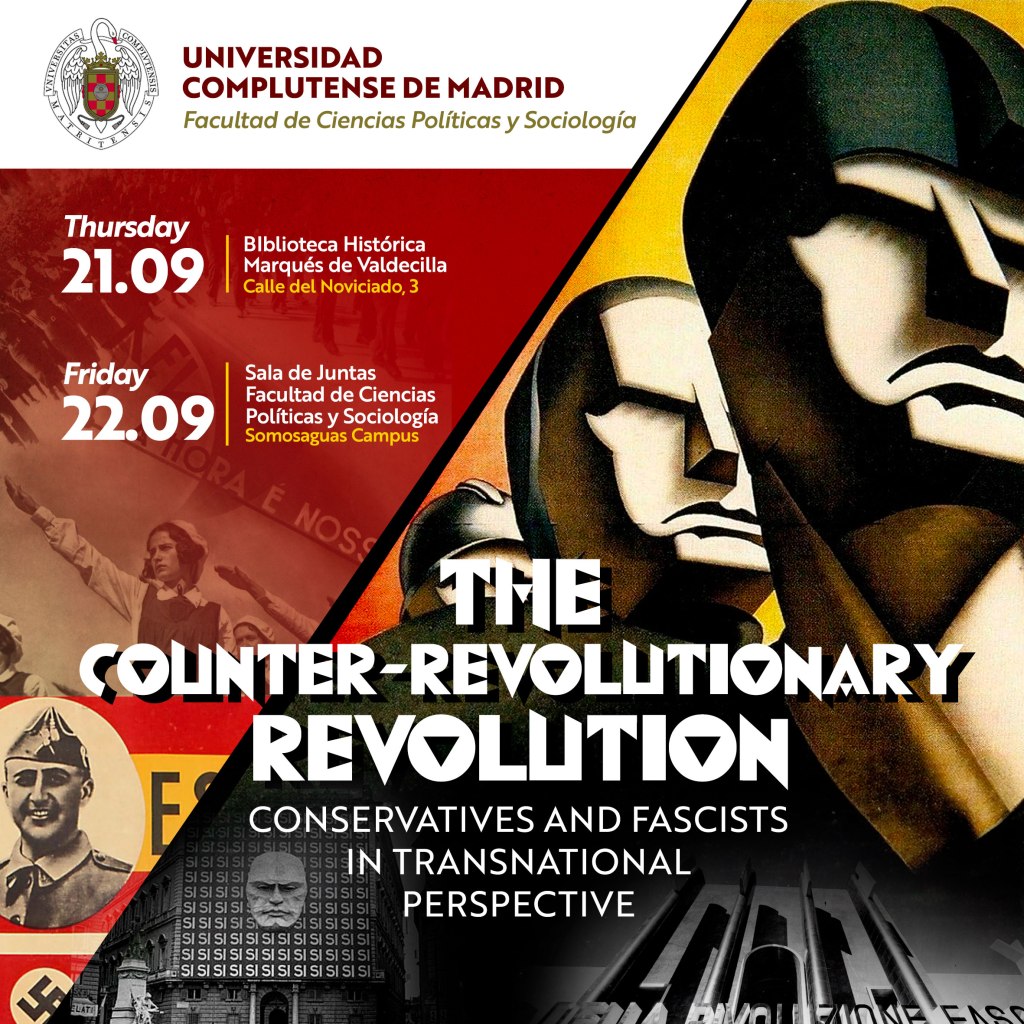
After trade flows, social policy and the environment, the transnational turn has recently impacted the study of conservatism and fascism as well. The MoH team decided to contribute to this trend organising an international conference entitled ‘The Counter-Revolutionary Revolution: Conservatives and Fascists in Transnational Perspective’, which took place on 21-22 September 2023 at the Complutense University of Madrid (co-organised with José Miguel Hernandez Barral, Alejandro Quiroga, Javier Muñoz Soro and Daniele Serapiglia).

In the last few years, the transnational approach has opened up new perspectives for research on the circulation of elements of the ideologies and practices of counter-revolutionary and fascist movements and regimes in inter-war Europe. The transnational approach has also emphasised the initially European and, later, global character of fascism and the counter-revolutionary Right as a response to the crisis of liberalism after the First World War. The conference thus aimed to contribute to the study of fascism and the counter-revolutionary Right as transnational phenomena by focusing on the appeal, external projection and reception of fascist and authoritarian regimes, ideologies and practices in Europe and beyond. Contributions ranged from the March on Rome as a transnational event, the reception of fascism in counter-revolutionary dictatorships in Spain, Portugal and Austria, the adaptation of fascist corporatism in southern European authoritarian regimes and the transnational participation of Italian ‘volunteers’ in the Spanish Civil War.

Emmanuel presented a paper entitled Betting on the wrong horse? Reimond Tollenaere, Staf De Clercq and Nazi transnational support to Flemish radical nationalists, which examined transnational influences, collaborations and dilemmas between radical nationalists in the Flemish-Dutch-German transnational space. There, he argued that the Flemish question during the interwar period embodied the contradictions of an age in which the nationality question that had been ubiquitous in the long 19th century ‘morphed into the minority question’ without disappearing altogether. The quickly nationalising population of Flanders was a demographic majority that, in many ways, behaved as a sociological minority, thus blurring the supposedly tidy lines of division between majorities and minorities, as well as between nationality questions and minority questions.

He also showed that the transnational activities of Flemish extreme-right nationalists and German authorities challenge traditional conception of the relationship between minorities and kin-states. On the one hand, several German actors from the late 19th century onwards identified the Flemings as part of the broader German Volk (as Niederdeutsche). On the other, despite pervasive pan-Netherlandic claims within Flemish nationalist circles, Flemish radicals looked much more towards Berlin than The Hague for support in their struggle for self-determination. Above all, under the Nazi occupation, Flemish extreme-right nationalists who worked to obtain external support, discovered that they were being treated as a German minority that had to be reabsorbed within the larger body of the German Volk. They thus confronted an irresolvable dilemma between their Flemish allegiance and their fascist ideological commitments. Having bet on the wrong horse, they sacrificed their self-determination goals to realpolitik and their allegiance to extreme-right ideals. He concluded that the Flemish story shows the relative and situational nature of the categories of majority, minority and nationality, which are as much self- as hetero-attributed.

Fascism, Minorities and Ambivalence

An article of the MoH Team in The Historical Journal

Source: Christoph von Hartungen, Fabrizio Miori, and Tiziano Rosani, eds., Le lettere aperte 1939–1943: L’Alto Adige delle opzioni (2 vols., Bolzano, 2006).

You have probably never heard of the 1939 Option Agreement between fascist Italy and Nazi Germany. Yet the agreement was the first population transfer agreement in western Europe. Emmanuel and Alessandro have decided to take a new look at this neglected event of interwar European history from the perspective of how the fascist regime conceived minorities and their assimilation in Italy.

Studying the 1939 Option Agreement offers a unique opportunity to shift the focus of the historiography on interwar minority questions from eastern to western Europe, thus challenging the lingering view of eastern Europe as a land of endemic ethnic heterogeneity and conflict. Furthermore, the 1939 Option illuminates a form of ‘consistent ambivalence’ that problematises dominant analytical frameworks concerning the management of ethnic differences. Indeed, Italian fascists consistently affirmed the inevitable assimilation, and therefore inclusion, of minorities within the Italian nation. At the same time, they also deeply distrusted the allogeni (the fascist term to refer to people considered as Italian citizens of non-Italian ethnic origin). This ambivalent attitude reached a climax in the 1939 Option. Hence in order to understand fascist behaviour during the implementation of the agreement, Emmanuel and Alessandro argues that we need to consider the longer history of fascist attempts to homogenise the new provinces since the onset of the dictatorship.

Three features structured these attempts: a belief that the assimilation of these minorities would be inevitable; the absence of means to carry out radical solutions; and a deep-seated distrust of the minorities. Fascist policy during the Option was simultaneously more ambivalent than the current historiography suggests and more consistent with the regime’s interwar homogenisation policies. The fascists, in wanting to include the populations living in South Tyrol and Venezia Giulia, believed that the minorities’ assimilation to the Italian nation was inevitable. However, the regime could not fully overcome its deeply rooted mistrust of the allogeni. Whereas assimilation was the declared and desired goal of Italian authorities, their distrust of the minorities living in the new provinces placed the latter in a liminal state of simultaneous forceful inclusion and latent segregation. Despite being coerced to adopt the cultural script of the majority, the allogeni were marginalised in a way that finds little echo in existing analytical frameworks on the management of ethnic differences.

Although the regime was not monolithic and there were disagreements between fascist officers about the approach to follow in South Tyrol and Venezia Giulia, the consistent ambivalence examined in this article reveals a patterned behaviour that was prevalent throughout the interwar period. In broader terms, the article challenges the traditional eastern European focus of the literature on the League of Nations, self-determination, and the rise of minority questions after the First World War. It shows that state authorities in the supposedly homogeneous and ‘civilised’ West did face minority questions and adopted harsh homogenising policies that, however, did not produce the expected results.

The article is available in open access at https://doi.org/10.1017/S0018246X23000158.

Victims of Their Own Rhetoric

Or how fascist authorities thought about and treated minorities in Italy.

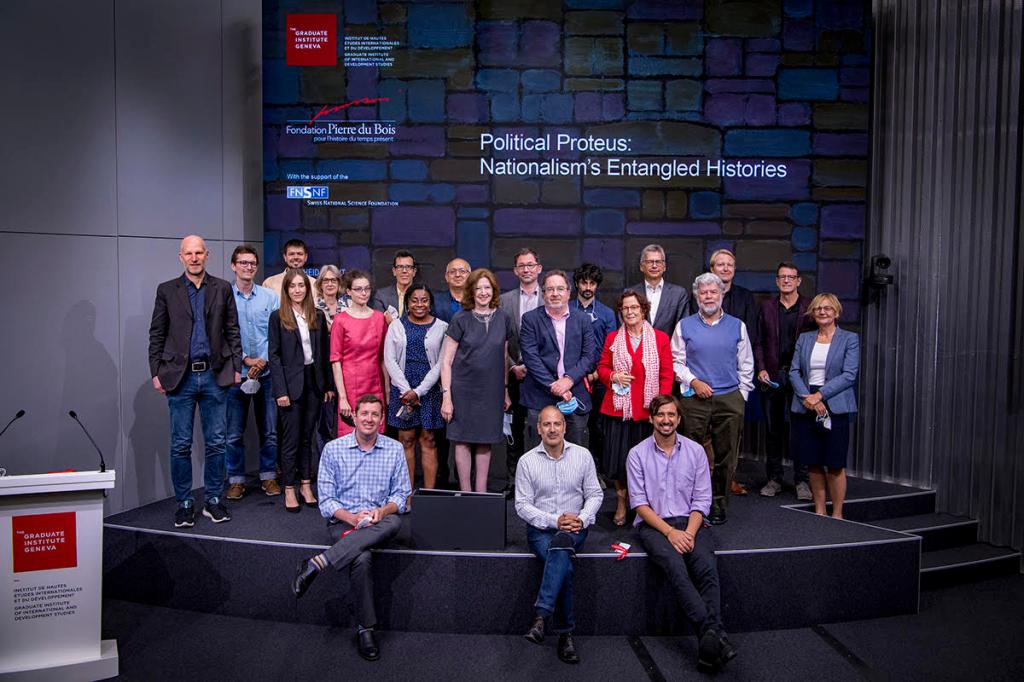
A picture of the participants in the 2021 Pierre du Bois Conference.
A picture of the participants in the conference.

As conferences are back, Emmanuel took part in the Pierre du Bois Annual Conference, organised by Professor Michael Goebel at the Graduate Institute, Geneva, on 26-27 August 2021. Under the title Political Proteus: Nationalism’s Entangled Histories, the conference explored the global history of nationalism at a time of renewed interest in the topic and salience in current affairs.

Emmanuel presented a paper co-authored with Alessandro entitled Victims of their own Rhetoric: The 1939 Option Agreement and the Consistent Ambivalence of Fascist Homogenisation Policy in the Italian New Provinces. The paper provides a re-reading of the 1939 Option Agreement between Italy and Germany in light of about two decades of fascist attempts at homogenising the border regions of South Tyrol and Venezia Giulia. It argues that although the behaviour of fascist authorities in the crucial months when 1939 drew to a close were ambivalent indeed, as many authors have already pointed out, that ambivalence was very much in line with the pattern followed by the regime throughout the interwar period. It thus concludes that such ‘consistent ambivalence’ was a key feature of fascist policy in the new provinces (as South Tyrol and Venezia Giulia were called at the time) and explains the bizarre behaviour of Italian officers in the second half of 1939.

As fascist Italy and Nazi Germany drew closer in the late 1930s, the Anschluss realised the Italian nightmare of a Greater Germany at its doors and Italian attempts to assimilate the population of South Tyrol continued to be disappointing (from the fascist perspective), finding a diplomatic solution to the question of South Tyrol grew ever more important. By mid-1939, the two countries came to an agreement whereby the population of the region would have to decide whether it wanted to remain in Italy or adopt German nationality and move north of the Brenner border. The Option Agreement, as it was called, was a strange hybrid between an option procedure, a plebiscite and a population transfer. It also created serious dilemmas for the two countries. Should they push for the transfer of all South Tyroleans or for as few as possible? The Nazi government needed men for the war effort. It was thus clearly in favour of a clean sweep solution. The Italian position was much more nuanced: while some were in favour of a total resettlement, many within the regime, especially at the local level were not. Furthermore, the Italian behaviour does not suggest a support for radical options. Nazi officers immediately began to spread propaganda in favour of resettlement (or to scare those South Tyroleans who wanted to stay, which actually were a majority). Italian authorities, in contrast, first remained silent. Then, when they realised that most people were inclined to vote for Germany, they tried to convince locals to stay. However, their propaganda was hampered by the strictures that their previous rhetoric and their fundamental distrust of the South Tyroleans imposed to their discourses.

The paper argues that this ambivalent approach was surprisingly consistent with fascist thinking about and treatment of Italy’s minorities. The ambivalence at the core of fascist policy in the new provinces stemmed from the combination of a naive belief that assimilation was inevitable – that the German-speakers of South Tyrol and the Slovenian and Croatian speakers of Venezia Giulia could not but assimilate to the great Italian civilisation – and a profound mistrust of the allogeni (as members of these two minorities were called at the time). Hence, the allogeni were simultaneously included by force in the Italian nation and marginalised in a liminal state of latent segregation.

The paper received positive comments and led to an interesting discussion about the differences between South Tyrol and Venezia Giulia, the precedent of the option procedure and the difficulties of co-writing an article.