Emmanuel will spend two months and a half at the Centre for History
After Antwerp in 2023, the MoH Team lands in Paris. This time, Emmanuel will be spending two months and a half completing the drafting of his monograph The Myth of Homogeneity: Minority Questions in Interwar Western Europe at the Centre for History of Sciences Po Paris. The research stay will also allow him to access material at the Archive of Foreign Affairs in La Courneuve concerning the transition from the minority protection system of the League of Nations to the human rights regime of the United Nations, which will be at the core of the Epilogue of the book.
The Epilogue argues that the so-called transition to individual human rights in 1946-1948, in fact, marked the triumph of an assimilationist conception of human rights, one that did not really privilege the individual, but rather some specific groups (national majorities) and penalised other groups (national minorities). France was at the core of efforts within the UN to reject the inclusion of any clause concerning protection against assimilation in the Universal Declaration of Human Rights. France, along with the United States and many Latin American countries, defended the idea that states can legitimately go to great lengths to promote the homogenisation of its population. As the French delegate within the UN Commission on Human Rights said in 1948: ‘the historical development of France into a homogenous State has resulted from the extensive and rigorous application of universal human rights to all sections of the population’ (my emphasis). In this respect, the Epilogue will expand on an argument that Mona and Emmanuel have already explored in the following paper: https://themythofhomogeneity.org/2021/10/
This stay also offered Emmanuel the opportunity to attend the many activities organised by the Centre for History, as well as to discuss his research with some excellent scholars that work there, notably Sabine Dullin, Matthieu Fulla, Marc Lazar, Guillaume Piketty, Paul-André Rosental and Jakob Voegel.
A new publication by the MoH Teamon the Nationalities Papers
Think of the immediate post-First World War period and the Paris Peace Conference will immediately come to mind. German reparations, disarmament and the League of Nations will probably ensue. Some of you would probably have heard of minorities, notably as a ‘problem’ in the eastern part of Europe that the Conference and the following League tried to solve. Most of these minorities, a few would also point out, were made of people who identified as Germans. Yet, very few of you would add that German minorities existed also in western Europe, notably in Belgium, France and Italy, which, at the end of the Great War, annexed territories with sizable German-speaking populations.
A paper written by Emmanuel, Alessandro and Volker Prott (from Aston University Birmingham), which has just been published in The Nationalities Papers, examines precisely this topic in a comparative perspective. The paper points out that in most accounts of peacemaking after the First World War, ‘flawed’ decisions at ‘Versailles’ caused the ethnically mixed states of central and eastern Europe to descend into violent ethnic clashes, while the allegedly more homogenous western European states faced few issues with minorities.
This article challenges such simplistic view by examining the treatment of German-speaking minorities in the borderlands of Alsace-Lorraine, South Tyrol, and Eupen-Malmedy in the immediate post-war and the early interwar period. Building on an innovative comparative framework of five key variables, the article finds that, in all three cases, post-war borders generated incentives for the respective governments to suppress their new minorities, and that states used ethnic markers to target them. However, the strength of state institutions and liberal principles account for a reversal (Alsace-Lorraine), moderation (Eupen-Malmedy), or hardening (South Tyrol) of measures. Furthermore, international commitment to defend the new borders and the absence of a tradition of ethnic violence also had a significant impact.
The paper is available in First View version at https://doi.org/10.1017/nps.2024.24 and should appear in print later this year or at the beginning of 2025.
Emmanuel presented a chapter of his next monograph at the prestigious Santos Juliá history seminar in Madrid
Innovations usually come from the West. This is the stereotypical view that has been prevalent in academia and outside for a long time. Yet in one field of academic research central and eastern Europe has been a trailblazer, both as an area of empirical research and as a site of knowledge production. From the early 2000s, researchers working on the history of this region have introduced and developed the concept of national indifference, along with further iterations of this notion such as instrumental nationalism and situative ethnicity. Although contested, these works have brought about a quiet revolution in the field of nationalism studies, questioning the nationalisation of European societies at the beginning of the 20th century and, more broadly, the pervasiveness of national identity as a form of identification that would supposedly be salient in all aspects of social life and at all moments. However, few authors have tried to apply national indifference to western European contexts.
In the third chapter of his new monographs, The Myth of Homogeneity: Minority Questions in Interwar Europe, which he is completing at the Complutense University of Madrid, Emmanuel is doing precisely that with majority-minority relations in interwar Belgium, Italy and Spain. On 29 February 2024, he presented the chapter at the prestigious Santos Juliá monthly seminar held at the Fundación Giner de los Ríos in Madrid (pictured above).
The chapter rejects a dichotomic view of nationalisation and national indifference, as if one had to choose between a world where nationalism is a driving principle of political legitimacy and social organisation and one in which it is irrelevant. On the contrary, the chapter defends the idea nationalisation and national indifference coexist and feed each other. This understanding of national indifference was there all along in the works of authors such as Pieter Judson, Tara Zahra and Jeremy King, who formulated the concept, but has somehow been lost from view in later works on the subject. Then, the chapter looks at the relationship between nationalist militants and the broader population in the Basque Country, Catalonia, Flanders, Eupen-Malmedy, South Tyrol and Venezia Giulia with a focus on the Wilsonian Moment (at the beginning of the interwar period), on education policy in these minority regions in the 1920s and 1930s, and on the radicalised context of the late 1930s, especially around plebiscites and elections held in these regions during those years. The chapter shows that although minority nationalist organisations were increasingly popular in these areas they still had a hard time mobilising voters around key items of their agenda, such as demands for autonomy as well as for schools in minority language. At the same time, the chapter also suggests that, while it is true that ordinary people in minority regions took into account a number of different principles and forms of identification in their everyday life beyond national identity and beyond the injunctions of nationalist minority leaders, the radicalised climate of the late 1930s, along with the holding of different plebiscites and elections (the latter cast as plebiscites in the public debate) in a number of these regions, somehow reduced the space for indifference.
A number of commentators shared their views on the chapter and made suggestions for improvements that will be integrated in later versions of the text. As usual, the session ended with an informal gathering at a nearby restaurant in Madrid, where the participants kept exchanging comments and opinions on nationalism, national identity, indifference and contemporary history more in general.
The MoH team co-organised a conference at the Complutense University of Madrid
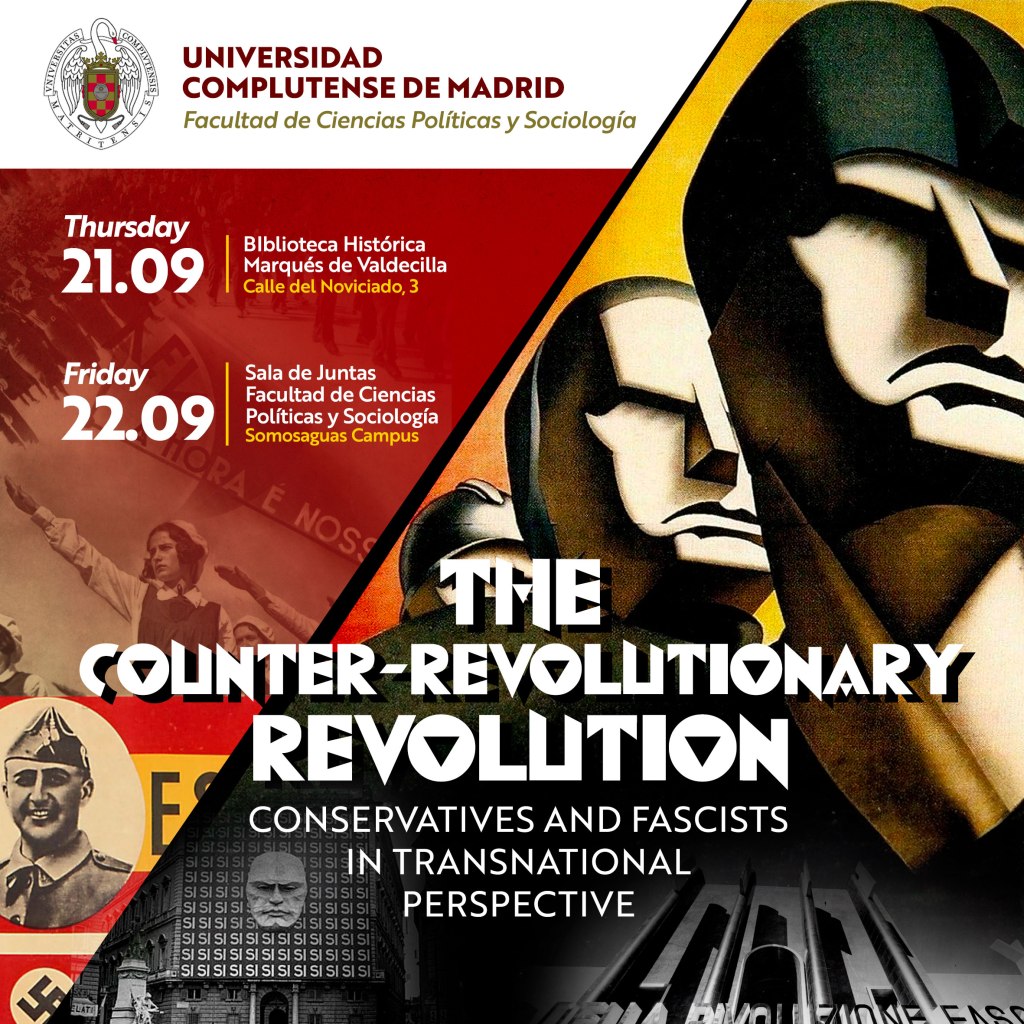
After trade flows, social policy and the environment, the transnational turn has recently impacted the study of conservatism and fascism as well. The MoH team decided to contribute to this trend organising an international conference entitled ‘The Counter-Revolutionary Revolution: Conservatives and Fascists in Transnational Perspective’, which took place on 21-22 September 2023 at the Complutense University of Madrid (co-organised with José Miguel Hernandez Barral, Alejandro Quiroga, Javier Muñoz Soro and Daniele Serapiglia).
In the last few years, the transnational approach has opened up new perspectives for research on the circulation of elements of the ideologies and practices of counter-revolutionary and fascist movements and regimes in inter-war Europe. The transnational approach has also emphasised the initially European and, later, global character of fascism and the counter-revolutionary Right as a response to the crisis of liberalism after the First World War. The conference thus aimed to contribute to the study of fascism and the counter-revolutionary Right as transnational phenomena by focusing on the appeal, external projection and reception of fascist and authoritarian regimes, ideologies and practices in Europe and beyond. Contributions ranged from the March on Rome as a transnational event, the reception of fascism in counter-revolutionary dictatorships in Spain, Portugal and Austria, the adaptation of fascist corporatism in southern European authoritarian regimes and the transnational participation of Italian ‘volunteers’ in the Spanish Civil War.
Emmanuel presented a paper entitled Betting on the wrong horse? Reimond Tollenaere, Staf De Clercq and Nazi transnational support to Flemish radical nationalists, which examined transnational influences, collaborations and dilemmas between radical nationalists in the Flemish-Dutch-German transnational space. There, he argued that the Flemish question during the interwar period embodied the contradictions of an age in which the nationality question that had been ubiquitous in the long 19th century ‘morphed into the minority question’ without disappearing altogether. The quickly nationalising population of Flanders was a demographic majority that, in many ways, behaved as a sociological minority, thus blurring the supposedly tidy lines of division between majorities and minorities, as well as between nationality questions and minority questions.
He also showed that the transnational activities of Flemish extreme-right nationalists and German authorities challenge traditional conception of the relationship between minorities and kin-states. On the one hand, several German actors from the late 19th century onwards identified the Flemings as part of the broader German Volk (as Niederdeutsche). On the other, despite pervasive pan-Netherlandic claims within Flemish nationalist circles, Flemish radicals looked much more towards Berlin than The Hague for support in their struggle for self-determination. Above all, under the Nazi occupation, Flemish extreme-right nationalists who worked to obtain external support, discovered that they were being treated as a German minority that had to be reabsorbed within the larger body of the German Volk. They thus confronted an irresolvable dilemma between their Flemish allegiance and their fascist ideological commitments. Having bet on the wrong horse, they sacrificed their self-determination goals to realpolitik and their allegiance to extreme-right ideals. He concluded that the Flemish story shows the relative and situational nature of the categories of majority, minority and nationality, which are as much self- as hetero-attributed.
The Myth of Homogeneity at the Po-His Seminar in Antwerp
Interwar European debates about national conflicts and the preservation of peace were awash with discussions about minority questions and the threat that their mismanagement posed to the preservation of the international order established in Paris. Does that justify treating majorities and minorities as homogenous entities in conflict, or at least in tension, during this period? Although it is clear that at the level of elite discourses and state and international policy there were minority questions in interwar Europe, does this allow us to conclude that European populations were neatly divided into self-conscious majorities and minorities?
On 20 April Emmanuel discussed issues of nationalisation, national indifference and instrumental nationalism in Belgium, Italy and Spain at a session of the weekly seminar of the Power in History (Po-His) research centre at the University of Antwerp. The paper entitled Within Minorities: Repertoires of Instrumental Nationalism in Interwar Western Europe is a draft chapter of the monograph on minority questions in interwar western Europe that Emmanuel is currently writing. The chapter challenges the homogeneity of minority groups in Belgium, Italy and Spain. It explores fluid identities among the populations living in minority areas, often caught between the opposing injunctions of state authorities and minority organisations. The chapter stresses how the boundaries dividing minorities and majorities were unstable and in flux. However, it also shows that in the interwar period, the ‘space’ for indifference towards questions of nationhood and belonging progressively shrunk.
The chapter builds upon and simultaneously moves away from the national indifference framework that since the mid-2000s has dominated studies on nationalism from below. It relies on a conception of nationhood as a property distributed with different degrees of intensity among the individuals of a specific population. While some individuals hold nationhood at the very core of their priorities and have a principled commitment to defending the national cause, others take more instrumental positions on the matter, which favour flexible patterns of behaviour that prioritise alternative, or compatible, forms of identification. Following a distinction proposed by Brendan Karch, the chapter inquires into the chasm between ‘“instrumental” social attitudes towards the nation and “value-driven” nationalism’. Instrumentally-minded actors ‘balanced national loyalties against a field of other commitments and values’, while value-driven activists pursued their national goals ‘nearly regardless of the means necessary to achieve them’.
The chapter applies this framework to different contexts in interwar western Europe. It first looks at the years immediately after the First World War and gauges the degree of mobilisation of minority societies in the context of the so-called Wilsonian Moment, when transnational activists attempted to lobby the great powers and other actors at the Paris Peace Conference in favour of their region’s self-determination, while hoping to rallying the local population in these areas behind their cause. It then moves the gaze to the defence of education in minority language at the regional level in democratic Belgium, especially in the late 1920s and during the 1930s, and in liberal and republican Spain, i.e. before the dictatorship of Miguel Primo de Rivera (in 1923) and during the Second Republic (1931-1936). The chapter examines how ordinary people’s behaviour often frustrated nationalist activists, who wanted to expand the use of minority languages within the school system. Finally, the chapter focuses on the very different context of Mussolini’s dictatorship in Italy and attempts to elucidate how people deemed to belong to minority groups in South Tyrol and Venezia Giulia navigated daily life in the fascist dictatorship through strategies of acceptance, acquiescence, and even enthusiastic collaboration.
Despite the absence of a unique pattern of mobilisation, interwar western European minorities were hardly self-conscious homogenous entities. Even if in most areas cultural and linguistic differentiation from the national majority supposed to identify with and control the state provided potential for national mobilisation, this never automatically translated into political activism. Ordinary people still had room for navigating between competing and complementary self-understandings, related to and beyond nationhood. Yet utter indifference to nationhood became ever more difficult in the radicalised climate of the late 1930s.
The paper received in-depth feedback from the participants in the seminar and Emmanuel is now working on a new version.
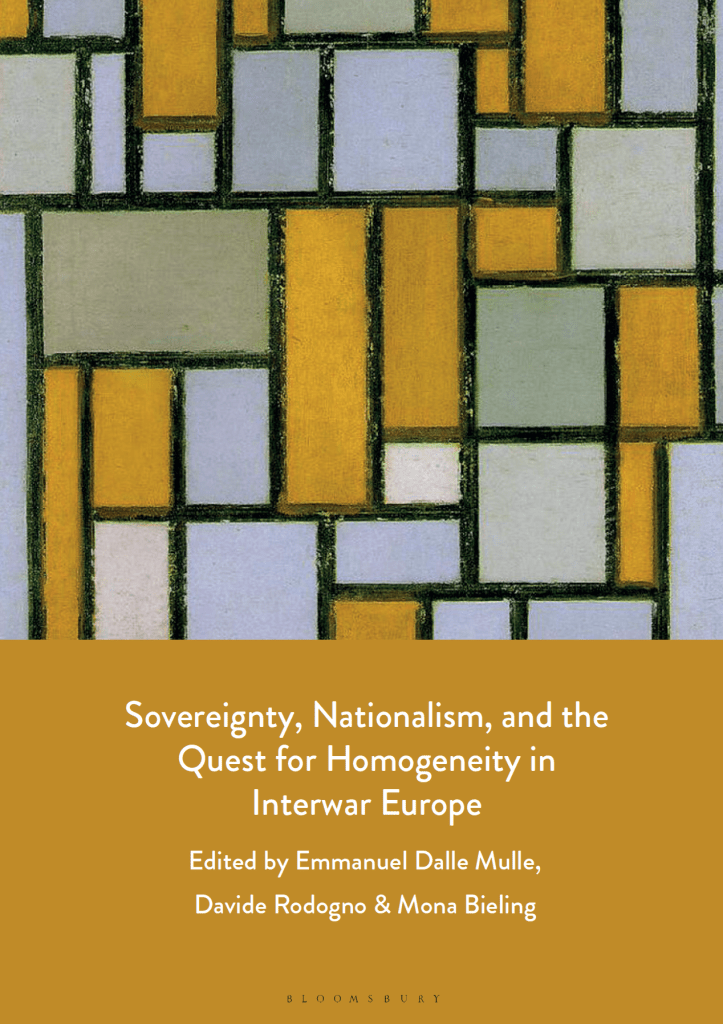
After about three years of work and a global pandemic, Sovereignty, Nationalism and the Quest for Homogeneity in Interwar Europe eventually goes to press. The edited volume will be released in print and electronic formats by Bloomsbury Academic on 18 May 2023 (click here for more info). The electronic version will be available in open access thanks to a grant from the Swiss National Science Foundation.
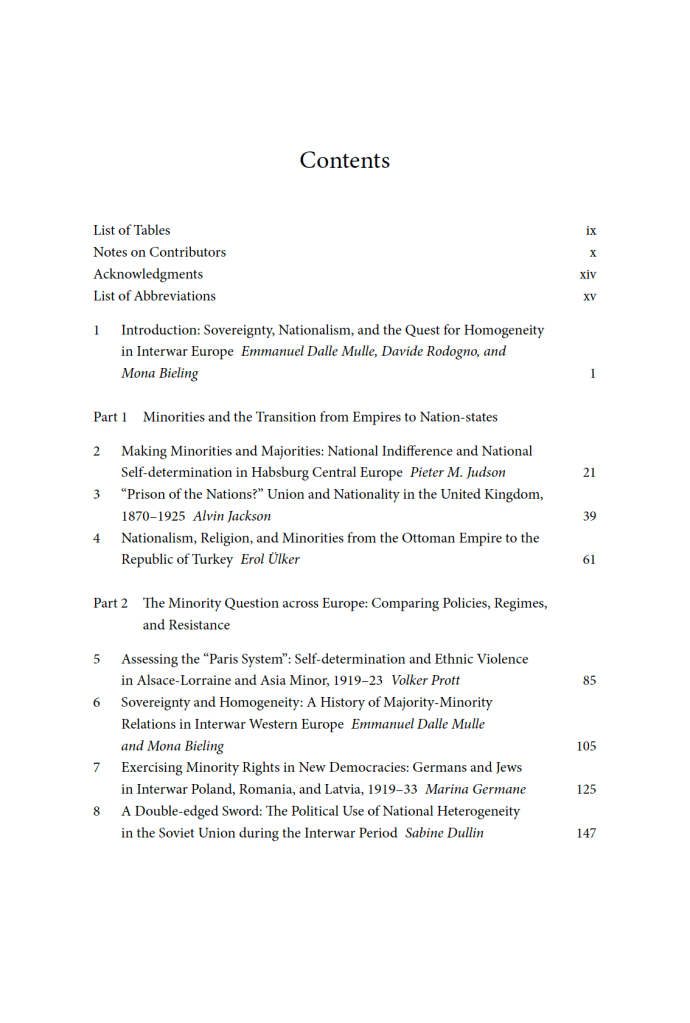
Through 14 chapters, the volume offers an in-depth, comparative and transnational study of minority questions in Europe focusing on, although not limiting itself to, the interwar period. The volume makes two major contributions to current historiographical debates on this topic. First, until now interwar European minority questions have been predominantly discussed in the context of eastern Europe. This volume challenges that geographical emphasis by examining both eastern and western European experiences. It thus lays the foundation for a new comparative international history of the relations between national majorities and minorities in Europe after the Great War. Second, building on the observation that nationalist conflicts are based on dynamic interactions between multiple actors, this book brings together different perspectives and methodological approaches (political, social, comparative and transnational) to provide a comprehensive account of minority questions between the two World Wars.
The volume is the result of a truly international collaboration featuring contributions from leading academics and emerging scholars based in Austria, Ireland, Poland, Spain, Switzerland, Turkey, the UK and the USA among others(see the table of contents below). We thank them all for their wonderful chapters.
The volume originated in the international workshop Sovereignty, Nationalism and Homogeneity in Europe between the Two World Wars that the Myth of Homogeneity team organised at the Geneva Graduate Institute in February 2020, right before the onset of the first wave of lockdowns outside China due to the global pandemic of covid-19. Some of the initial participants left, while others joined at a later stage. Among the many people that have taken part in this journey with us, we would like to remember Eric Weitz. Eric was supposed to write the conclusion of our volume with a chapter based on the memorable keynote that he gave at the end of our Geneva workshop in February 2020. Unfortunately, Eric left us in July 2021. The volume is dedicated to him.
The research behind this volume has been funded by the Swiss National Science Foundation (grant n. 169568) and the European Union’s Horizon 2020 research and innovation program under the Marie Skłodowska-Curie grant agreement no. 847635. The Pierre du Bois Foundation contributed to covering editing expenses. We thank them all for their generous support.
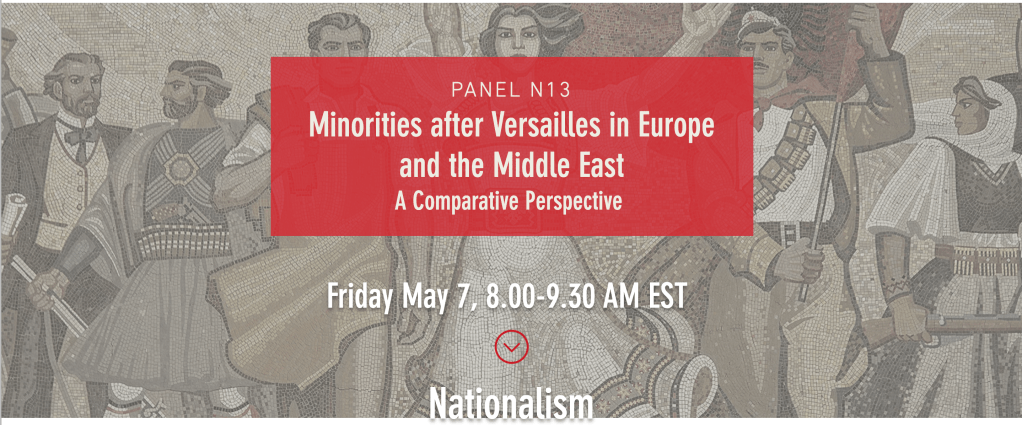
Thanks to the recent improvement of the sanitary situation in Europe, the team of the Myth of Homogeneity is again presenting research results at international conferences. The ‘awakening’, after more than a year of forced inaction, began already in May 2021, when the team organised a panel at the Annual Convention of the Association for the Study of Nationalities (ASN). This year, the event, which usually takes place at Columbia University in New York, was held online. The panel, entitled Minorities after Versailles in Europe and the Middle East: A Comparative Perspective, explored interwar majority-minority relations in a broad comparative framework fostering dialogue between experts specialised in different geographical areas and political contexts.
The three contributors to this panel explored the contradictions and intricacies of the new international order ushered in at the Paris Peace Conference, an order based on population politics and a lingering tendency to seek national homogeneity. Sarah Shield (University of North Carolina at Chapel Hill) argued that, after the Great War, the Great Powers mobilised ‘self-government’ in the Middle East to legitimise foreign rule (through the mandate system), to excuse violence (for instance in the French Syria), and to alienate territory (as in Palestine). Building on the cases of Alsace-Lorraine and Asia Minor, Volker Prott (Aston University Birmingham) inquired into the factors that explain differences in patterns of conflict and violence between these two areas. Finally, Chris R. Davis (Lone Star College-Kingwood) shifted the focus from minorities to majorities and dissected how transnational networks of ethnologists in Romania and Hungary shaped notions of belonging relating to the respective majorities and minorities in either country. Overall, the three papers emphasised to the need to expand the comparative study of minorities in Europe and the Middle East, and, especially, to connect the largely self-contained literatures on minority protection, on the one hand, and the mandate system, on the other.
In August, the team will be presenting a paper at the Annual Pierre Du Bois Conference, which will take place at the Graduate Institute in Geneva. The event, organised by the Pierre du Bois Foundation and Professor Michael Goebel, will feature distinguished speakers from universities across the globe. The team’s contribution will examine fascist policies of assimilation in interwar Italy. Taking as a starting point the 1939 Option Agreement between Italy and Germany on the ‘voluntary’ resettlement to the German Reich of the inhabitants of the German-speaking Italian area of South Tyrol, the paper argues that the ambiguities inherent in the agreement and in the fascist approach to the Option reflects the larger history of attempts at assimilating minorities in Italy (both in South Tyrol and Venetia Giulia, the other minority region annexed by the Italian Kingdom at the end of the Great War). More specifically, the paper shows that fascist policies of assimilation were characterised by three main features: a naïve belief that the assimilation of these minorities would be an easy task; the lack of means to carry out radical solutions; and a deep-seated distrust of the allogeni (as Italian citizens of non-Italian origin were called at the time), even of those who willingly assimilated to Italian culture and who enthusiastically joined the Fascist Party. As a result, the ambivalent policy pursued by fascist authorities during the period of the Option was consistent with previous attempts at assimilating the German-speaking populations of South Tyrol.
The Minorities in Contemporary and Historical Perspectives Monthly Series comes to an end. Thanks to all our authors for their insightful contributions and to our readers for their attention.
In these days of looming confined holidays and mass vaccination campaigns, majority-minority relations might not strike as the topic of the day. However, several posts in our Minorities in Contemporary and Historical Perspective series suggest that cultural, linguistic and national differences in modern societies can still be a source of contention and often require setting up specific political arrangements to further positive inter-group relations. The first part of our series privileges an historical approach inquiring into the origins of minority questions and dissecting long-term trends in majority-minority relations.
Laura Robson starts off our discussion with a lucid piece about the establishment of the first minority protection regime by the League of Nations in 1919. Robson argues that, behind the smokescreen of minority rights, Great Power interest and colonial exploitation could be pursued under a veneer of international respectability. Hence, ‘new forms of informal authority and friendly client states’ were created at Versailles, which would eventually undermine the legitimacy of the League of Nations regime. In the Middle East, as well as in Eastern Europe, the transition from imperial sovereignties to the nationalist system sanctioned at the Paris Peace Conference unleashed strong homogenising dynamics. Focusing on the case of Christian minorities in French-Occupied Syria, Joel Veldkamp examines the ‘nationalist dilemma’ confronted by Syrian nation-builders. After having tried, unsuccessfully, to include Christian minorities in their nation-state-in-the-making project, these elites moved from persuasion to coercion, thus shattering any chance to build a cohesive Syrian nation (and generating a substantial amount of violence in the process).
As Yoav Peled shows, in Eastern Europe, Polish elites followed similar assimilationist templates. Confronted with a highly diverse country and willing to forge a cohesive nation-state, both dominant Polish parties (Endecja and Sanacja) ‘were determined to make Poland a homogeneous state in the shortest time possible’. Jewish and German minorities, among others, bore the brunt of this political programme, but ‘while assimilation of the Germans into Polish society was seen as unlikely, assimilation of the Jews was seen as undesirable’. Assimilation failed, but between 1939 and 1945 the linguistic and national heterogeneity of Polish society changed dramatically because of war, ethnic cleansing and genocide. Albeit much less diverse than in the previous two decades, at the end of the Second World War, Poland also acquired new territories formerly under German rule. John Kulczycki tells us how, in these putative ‘Recovered Lands’, Polish authorities set out to sort ‘true Poles’ from ‘Germans’. Recovering ‘Polish souls’ became a national priority, albeit one for which officers tasked with inquiring into the ethnic nature of the inhabitants of these regions received few guidelines. After about two years of mass expulsion, the Polish Ministry of the Recovered Lands had to recognise ‘the impossibility of creating an objective criterion that would differentiate a German from an autochthon’. As the Polish case suggests, in interwar Europe minorities became an ‘issue’ mostly because majorities felt insecure about the latter’s loyalty to the institutions of the state, which these majorities felt as their own. Chris Davis then historicises the minority question in interwar Romanian Transylvania as a ‘majority problem’, ‘namely that there were too few Romanians, living too far apart, in a region far too important’. To solve this problem, Romanian anthropologists and historians found a creative solution. Armed with presumably scientific data, they asserted that the sizable Hungarian-speaking population of Transylvania ‘possessed a Romanian ethnogenesis’ and had simply been ‘denationalised’ during centuries of Hungarian rule. Against the background of these theories, assimilation in fact became ‘renationalisation’ and minority rights could be all too easily ignored.
The second half of our series moves from historical analysis to contemporary affairs. Ferran Requejo illuminates the old and recent causes of the considerable rise of demands for independence in Catalonia since 2010. Discussing different factors, ranging from economic to identity variables, Requejo concludes that ‘lack of national recognition and accommodation shown by the Spanish state has played a decisive role in causing the predominant Catalan demands to shift from being regionalist or pro-autonomy towards secessionism’. Whatever the outcome of the current tensions between the Catalan and Spanish executive, the Catalan case constitutes an unavoidable reference for the study of self-determination processes in Europe. Adopting a similar mix of historical and political science analysis, Brian Girvin dissects 100 years of majority-minority relations in Northern Ireland. Girvin explains how, by undermining the very concepts of majority and minority, the Good Friday Agreement promoted consensus and cooperation between the Protestant and Catholic communities in Northern Ireland. It created a ‘consociational model for power sharing, political cooperation and conflict resolution’ that put the two nationalities on equal terms. Despite its remarkable success, however, demographic changes and Brexit risk unsettling the balance achieved at the end of the 1990s.
Our series concludes with three blogs stemming from a very fruitful collaboration with the Centre on Constitutional Change. Writing about Scotland, Michael Keating argues that Scots are not usually seen as a national minority identifying with a kin-state elsewhere but as a minority nation within a plurinational union. Keating explains that ‘Scottish politics have become more self-referential and detached from the British level’, with the COVID-19 crisis allowing the Scottish Government to occupy the main political space. Yet, Scottish independence is not inevitable. Even in the event of independence, Scotland would remain a small nation nested in larger systems of regulation and policy-making. Judith Sijstermansdetails how dominant strands of Flemish nationalism have incorporated populist narratives and how this populist turn has led to the adoption of an identitarian approach. Sijstermans explains how, in Vlaams Belang’s rhetoric, ‘Flemish autonomy from the Belgian state is interwoven with an anti-elite search for autonomy from broader local and international “elite” who are portrayed as corrupt, anti-democratic, and in opposition to the Flemish volk (people)’. Finally, Patrick Utz dissects the complex and multi-layered nature of national identities in South Tyrol, suggesting that they underpin the success of its consociational institutional design. Utz explains that new forms of regionalism are allowing for a patchwork of identities that combine reinterpretations of historic elements with newly emerging alliances. The SVP offers an illuminating example: the party has become more vocal in portraying both Austria and South Tyrol as ‘motherland’ while promoting a ‘European Region of Tyrol’ as part of the European Union’s cross-border initiatives.
We hope that you have enjoyed the series and we encourage you to continue the discussion commenting on our posts. You will find a full list here.
We thank all our authors for their inspiring contributions; the Graduate Institute of International and Development Studies, the Centre on Constitutional Change, and the Swiss National Science Foundation for their support; H-Nationalism, in particular David Prior, for giving us the opportunity to run the series on their platform; and all our readers for their attention. A special thanks also goes to Mona Bieling, Alessandro Ambrosino and Davide Rodogno for their fundamental help.
Hoping that 2021 will be a less eventful and more cheerful year, we wish you all the best!
Emmanuel Dalle Mulle and Daniel Cetrà
The Minorities in Contemporary and Historical Perspective series is organized by the Myth of Homogeneity Research Project at the Graduate Institute of International and Development Studies, Geneva, and the Centre on Constitutional Change at the University of Edinburgh.
H-Nationalism is proud to publish here the tenth post of its “Minorities in Contemporary and Historical Perspectives” series, which looks at majority-minority relations from a multi-disciplinary and diachronic angle. Today’s contribution, by Patrick Utz (University of Edinburgh), examines the fluid identities of German-speakers in South Tyrol in the 20th and 21st century.
South Tyrol or Alto Adige is Italy’s northernmost province. Mainly populated by German-speakers, the province became part of Italy after the breakup of Austria-Hungary in 1919. Today, far-reaching autonomous competencies and a mandatory power-sharing system includes both German and Italian-speakers. This has assured the peaceful cohabitation of the province’s diverse population. But while contemporary institutions are modelled around linguistic identities, South Tyrol has always been shaped by a multitude of overlapping and frequently ambiguous allegiances. Unpacking this complexity allows for important insights beyond South Tyrol: it sheds new light on how national minorities relate to culturally akin, neighbouring countries without raising fears of historical revanchism and irredentism.
Traditionalist regionalism
When South Tyrol became part of Italy, regional identities tended to be stronger than the linguistic-nationalist divisions that surfaced later in the twentieth century. Allegiances lay with the former Habsburg Crownland of Tyrol that included German-speakers and Italian-speakers between the river Inn in the North and the Lake Garda in the South. This identity built on Catholic conservativism and the collective memory of the resistance against Napoleonic troops in this mainly agrarian region. Clearly, these tenets were at odds with the liberal ideas that inspired the Risorgimento and shaped the Italian state into which South Tyrol was incorporated.
This alienation was not exclusive to the German-speaking minority that found itself in a new nation-state. It was shared by many Italian-speaking Tyroleans in what is now the Province of Trento. Indeed, Trento’s Catholic tradition would become influential within Italy’s powerful Christian democratic movement after 1945. Additionally, in the Austrian part of Tyrol, notions of the wider multilingual region never entirely faded. North Tyrol’s main university, for instance, has continued to offer Italian-language courses and hosts a faculty of Italian law.
By the middle of the twentieth century, however, increasingly aggressive forms of nationalism on both sides of the linguistic divide superseded patterns of pre-modern, regional identification.
Nationalist excesses and their remnants
National identities based on linguistic differences had taken shape over the course of the nineteenth century but were exacerbated with the rise of Nazism in Germany and Fascism in Italy. While the Italian Fascists aimed to forcefully assimilate German-speaking South Tyroleans, many among the latter hoped for South Tyrol to be incorporated into Hitler’s Reich. As part of their political rapprochement in the 1930s, the Italian and German regimes sought to resolve the issue of South Tyrol through population resettlement. German-speakers should decide whether they wanted to stay in South Tyrol, with the prospect of being forcefully assimilated; or whether they wanted to be resettled to the Reich. The plebiscite on resettlement deeply dived Italy’s German-speaking minority. The two sides accused each other of betraying their German national heritage or their Tyrolean homeland, respectively.
Large-scale resettlement never materialized amidst the devastation of the Second World War. Yet, the plans to do so revealed the deep-seated tension between those South Tyroleans who subscribed to German nationalism; and those, who maintained a regional identity where local allegiances trumped linguistic divisions.
After the Second World War, South Tyrol’s political elites aimed to reconcile these two camps within a common political structure for the whole German-speaking minority. This led to the creation of the South Tyrolean People’s Party (Südtiroler Volkspartei, SVP) in 1945. The SVP was highly successful in bringing together the different segments of the German-speaking minority and obtained over 90 percent of German-speakers’ votes. Yet, the defining characteristics of the minority remained contested. One wing considered the German-speaking South Tyroleans to be a linguistic-cultural group within the wider region of Tyrol that was now split between Austria and Italy. The other wing emphasized South Tyroleans’ membership within a larger German nation.
None of the resulting political aspirations put forth by either wing could feasibly be pursued in South Tyrol’s post-war environment. The aggressive nationalisms had irreversibly politicized the linguistic differences in South Tyrol. Thus, multilingual regionalism was no longer an option. At the same time, Western Europe’s emerging security structure solidified state borders and discredited all forms of pan-Germanism, which precluded the option of secession.
Re-interpreting regionalism
The SVP’s compromise was to demand autonomy for German-speakers within the Italian state, and a neat separation of South Tyrol’s language groups in public institutions. The reinstated Republic of Austria and the Austrian Tyrol were crucial in supporting this cause, despite Austria’s eagerness to differentiate itself from its own infamous German nationalist heritage.
The SVP and Austria’s negotiations with the Italian government succeeded in 1969. Since then, robust mechanisms for territorial autonomy and minority self-government have gradually been put in place. The autonomous institutions have substantially contributed to South Tyrol’s political stability and economic success. This has turned the institutions themselves into a reference point for collective identification. In 2014, more than 80 percent of German-speakers in the province identified as “South Tyroleans”. Allegiances with pan-Germanic and wider Tyrolean identities have markedly weakened.
At the same time, new forms of regionalism are allowing for a patchwork of identities that straddle linguistic and political borders. Oftentimes the resulting identities combine reinterpretations of historic elements with newly emerging allegiances. The SVP, for example, has become more vocal in portraying Austria as South Tyrol’s “motherland”. This stands in sharp contrast to the party’s previous commitments to the broader German cultural heritage. Simultaneously, the party promotes a “European Region of Tyrol” as part of the European Union’s cross-border initiatives. This embryonic entity resembles the historic Crownland of Tyrol and includes Italian and Germanic-dominated regions. Voters, too, have shown appetite for more political diversity. Votes still tend to be overwhelmingly cast to candidates from one’s own linguistic group. Yet, the once hegemonic conservative SVP now is in fierce competition with liberals, Greens and the populist right; with each challenger presenting their own vision of a South Tyrolean identity.
Conclusion
South Tyrol’s autonomous institutions may correctly be commended as “one of the most successful cases of consociational conflict regulation in the world”. The reasons for their success lie as much in their institutional design as they do in the complex and multi-layered identities of the province’s population. The nationalist excesses of the twentieth century have essentialized individual traits of these identities (in this case, language). However, the recognition of multiple, simultaneously held allegiances can dilute national antagonisms. The future success of South Tyrol’s institutions and of those with the aim to replicate its model depends on giving voice to this diversity.
Sources
Alber, Elisabeth, and Carolin Zwilling. “Continuity and Change in South Tyrol’s Ethnic Governance.” In Autonomy Arrangements around the World: A Collection of Well and Lesser Known Cases, edited by Levente Salat, Sergiu Constantin, Alexander Osipov and István Gergő Székely, 33-66. Cluj-Napoca: Editura Institutului pentru Studierea Problemelor Minorităţilor Naţionale, 2014.
Carlà, Andrea. “Peace in South Tyrol and the Limits of Consociationalism.” Nationalism and Ethnic Politics 24, no. 3 (2018): 251-75.
Grote, Georg. The South Tyrol Question, 1866–2010: From National Rage to Regional State. Oxford: Peter Lang, 2012.
Pallaver, Günther. “The Südtiroler Volkspartei: Success through Conflict, Failure through Consensus.” In Regionalist Parties in Western Europe: Dimensions of Success, edited by Oscar Mazzoleni and Sean Mueller, 107-34. New York: Routledge, 2016.
Steurer, Leopold. “Südtirol 1918-1945.” In Handbuch Zu Neueren Geschichte Tirols. Band 2: Zeitgeschichte. 1. Teil: Politische Geschichte, 179-312. Innsbruck: Universitätsverlag Wagner, 1993.
Patrick Utz is a PhD candidate in Politics at the University of Edinburgh. His research focusses on minority nationalism, irredentism and kin-state politics. It has been published in Nationalism and Ethnic Politics.
The Minorities in Contemporary and Historical Perspective series is organized by the Myth of Homogeneity Research Project at the Graduate Institute of International and Development Studies, Geneva, and the Centre on Constitutional Change at the University of Edinburgh.
For more information, please visit:
The Minorities in Contemporary and Historical Perspective series is organized by the Myth of Homogeneity Research Project at the Graduate Institute of International and Development Studies, Geneva, and the Centre on Constitutional Change at the University of Edinburgh.
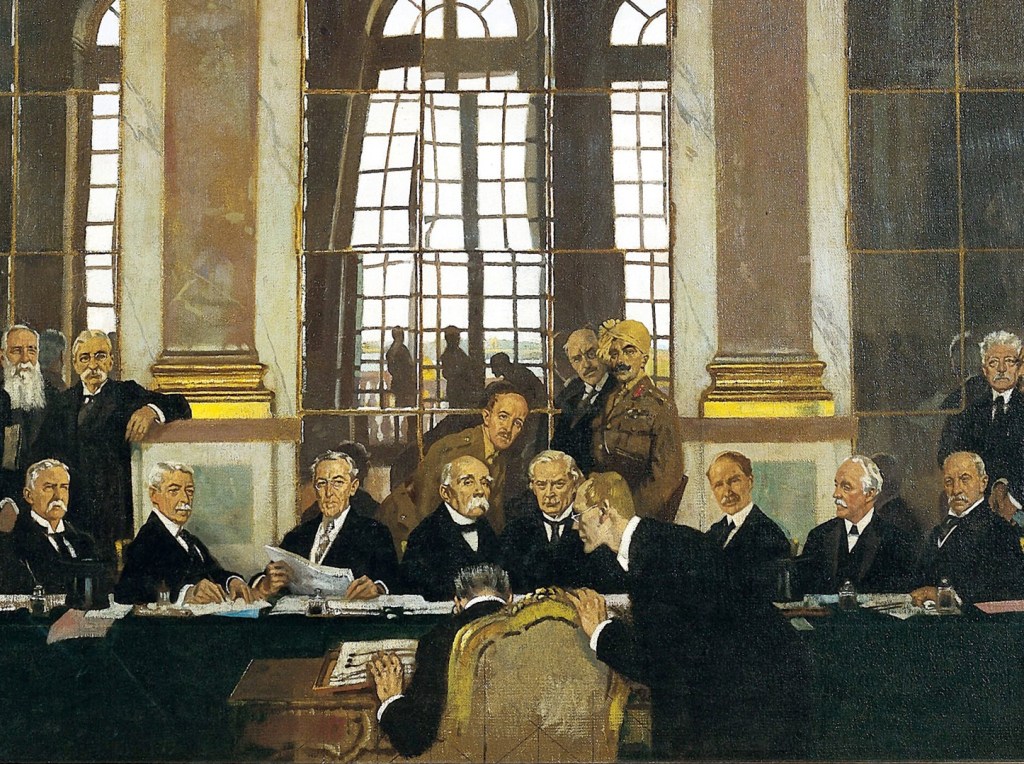
We are proud to publish here the first post of our “Minorities in Contemporary and Historical Perspectives” series, which looks at majority-minority relations in a multi-disciplinary and diachronic perspective. Today’s contribution, by Professor Laura Robson (Portland State University), provides some considerations on the origin, nature and purpose of the Minorities Regime established by the Great Powers at the end of the First World War. The series is a collaboration with H-Nationalism.
The
treaties of Versailles, Sèvres, San Remo, and Lausanne are sometimes conceived
as the beginnings of a new kind of international rights regime, prefiguring the
legal edifice of “human rights” that began to emerge after 1945 and eventually
became a central aspect of Cold War internationalism. And indeed, the treaty
arrangements of the postwar period did collectively produce a new language of
international diplomacy that replaced a nineteenth century imperial discourse
of “civilization” and “race” with a twentieth century discourse of rights: in
particular, the rights of minorities, which came to stand as a representation
of a new and theoretically more politically equitable global order. But this
rhetoric did not actually signal the birth of a new political system. It served
instead as a kind of code, intended to veil the old-fashioned militarism of
this new form of extractive empire and to put in place procedures for
reinforcing, without acknowledging, the racial hierarchies that underlay the
system’s careful differentiation of sovereign rights across the globe. In other
words, the peace agreements of 1919-1923 represented an attempt to appropriate
an emerging language of national rights, and especially minority rights, for
the purpose of maintaining an older imperial order.
In
1919, the architects of the peace agreements who came together at Versailles
faced a fundamental problem. They had spent the last four years fighting a war
that was essentially in defense of more or less permanent imperial expansion,
but whose trajectory had inadvertently led to a considerable strengthening of
anti-imperialism across the globe – particularly in the Bolshevik sphere, where
Lenin was making declarations of withdrawal from Russia’s imperial commitments
as a way of winning adherents to his cause. So the question for the peacemakers
– particularly representatives of Britain and France, who were absolutely
determined to make their brutal four years pay dividends – was how to reconcile
the anti-colonial feeling of the day with their undiminished imperial
ambitions. Facing this difficulty, the political and diplomatic leaders of the
old “Great Powers” began envisioning a new global order comprised of
self-consciously modern, theoretically sovereign states under the continued
economic and political authority of the old imperial powers.
The
first “rights” frameworks to emerge were the multiple minorities treaties
signed with the new states emerging out of the shatterzones of the Ottoman,
Russian, and Austro-Hungarian empires. All modeled after the first treaty
signed with Poland at Versailles in 1919, they called for equal rights for all
citizens, the free exercise of religion and cultural practice, and some
mechanisms for protecting cultural distinctiveness. Though they agreed on
little else, representatives of the United States, France, and Britain all
concurred that the League must not guarantee universal protections for
minorities that would apply in their own metropoles; and so the treaties were
limited to the “new or immature states of Eastern Europe or Western Asia” –
thereby deliberately enshrining the idea that minority communities represented
a legitimate site of external intervention into the affairs of theoretically
sovereign but less “civilized” nations.[1]
In other words, they deployed the emerging concept of minority as a new
legitimization of an old practice: Great Power political, economic, and
military intervention in the Balkans and beyond.[2]
Simultaneously
and relatedly, the Allied architects of the peace treaties declared that the
post-war project of drawing new maps would reflect national interests – thus
hopefully appeasing nationalist sentiment while reserving the right to
construct new states in ways that would support ongoing imperial ambitions.
Arguments over the shape and demographic makeup of Poland, Hungary, and Romania
– among many others – were cloaked in a rights-based language about
self-determination and nationhood, but actually represented Allied efforts to
isolate Germany and construct a cordon
sanitaire between themselves and the Bolsheviks.[3]
In the Treaty of Lausanne,
signed in 1923, this imperially sponsored construction of nationality was taken
to a new level. Lausanne formalized what was euphemistically called a “population
exchange” between the new revolutionary Turkish government of Mustafa Kemal and
Eleftherios Venizelos’ Greek administration, forcibly denationalizing
approximately 1.2 million Anatolian “Greeks” and 350,000 Muslim “Turks” under
the aegis of the League of Nations. This 1923 exchange confirmed the post-war
Allied commitment to deploying a language of “national rights” and minority
protection to support the political and, especially, economic interests of
their own empires. Fridtjof Nansen expressed the combination of these criteria
precisely in a statement to the Commission in 1922, saying that the “Great
Powers” supported the exchange because “to unmix the populations of the Near
East … is the quickest and most efficacious way of dealing with the grave
economic results [of the war].”[4]
In
other words, the appearance of a new discourse of minority rights – and its
corollary, minority “exchange” – in the post-WWI treaties was almost entirely
instrumentalist. Its primary rationale was not to protect minorities in Eastern
Europe or the Ottoman sphere but to smooth the path for imperial powers to
create new forms of informal authority and friendly client states for a new
postcolonial era. As Mark Sykes – co-author of the infamous Sykes-Picot agreement
of 1916 – wrote during the 1919 peace conference, “Imperialism, annexation,
military triumph, prestige, White man’s burdens, have been expunged from the
popular political vocabulary, consequently Protectorates, spheres of interest
or influence, annexations, bases etc., have to be consigned to the Diplomatic
lumber-room.”[5]
Luckily, it seemed, the rhetoric of national – and especially minority – rights
that was gaining such currency around the globe would substitute nicely.
Laura Robson is Professor of history at Portland State University in Portland, Oregon. Her most recent books are States of Separation: Transfer, Partition, and the Making of the Modern Middle East(University of California Press, 2017) and the edited volume Partitions: A Transnational History of 20th Century Territorial Separatism (with Arie Dubnov; Stanford University Press, 2019).
Scholars interested in contributing to
the series can contact:
[2] And fitting into a much longer
practice of international diplomacy that sought to formalize relations among
the “three elements of the international legal order” identified by legal
historian Nathaniel Berman: “(1) a substantively grounded international
community … ; (2) sovereigns, whose ‘potency’ and ‘serenity’ are periodically
reimagined; (3) those viewed as not full participants in the community of
sovereigns, those ‘Vassals, Subjects, People.’ ” See Nathaniel Berman, Passion
and Ambivalence: Colonialism, Nationalism, and International Law (Leiden:
Nijhoff Publishers, 2012), 58.
[3] Carole Fink, Defending the Rights of Others: The Great Powers, The Jews, and
International Minority Protection, 1878-1938 (Cambridge: Cambridge
University Press, 2006), 119.
[4] Great
Britain, Parliamentary Papers, Turkey No.
1 (1923) Lausanne Conference on Near Eastern Affairs, 1922-1923 (Cmd. 1814)
(London: HMSO, 1923), 117.
[5] Sykes,
“Our Position in Mesopotamia in Relation to the Spirit of the Age,” FO 800/22.
The full document is also reprinted in Helmut Mejcher, The Imperial Quest for Oil: Iraq 1910-1928 (London: Middle East
Centre, St. Antony’s College, 1976), appendix 2.








 The Myth of Homogeneity