What is Flanders? This provocative question lies at the core of a new publication from the Myth of Homogeneity project just appeared in Contemporary European History. The publication argues that answering this question can move this European region from the margins of international historiographies on the inter-war period to the centre of an alternative account of minority and nationality questions after the First World War.
Scholarship on minorities in the inter-war period have largely ignored the Flemish question. One obvious reason is that the Flemish accounted for a majority of Belgium’s population. This article, however, argues that the domestic and international historiography would benefit from considering the Flemish a minority, albeit a peculiar one. It suggests that the Flemish question embodies the contradictions of an age in which the nationality question ‘morphed into the minority question’ (as Holly Case has pointed out) without disappearing altogether.
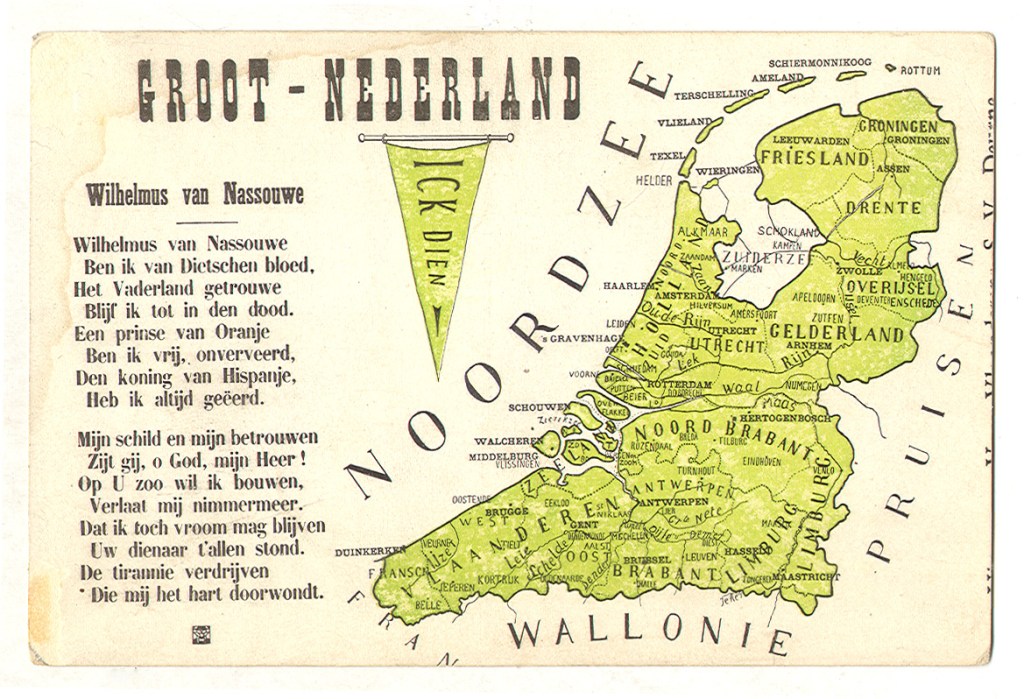
The article traces the evolution of different understandings of Flanders in the Belgo-Dutch-German transnational space. Within this context, different understandings of the Flemish population coexisted from the end of the First World War until the 1940s: as a region of Belgium with cultural ties to the Netherlands; as an oppressed nationality and a majority in Belgium that fought for linguistic protection and equality like many minority communities across Europe; as a nation endowed with a right to self-determination; as the smaller part of the Greater Netherlandic nation; as low Germans (Niederdeutsche) and thus members of the broader German Volk. Most of these understandings located Flanders at the frontier between majority and minority, and the Flemish question between a minority question of the inter-war years and a nationality question of the pre–First World War age.
The article follows the evolution of these understandings during the inter-war period, focusing particularly on understandings that were pursued by radical Flemish nationalists and their German allies. It shows how Flemish radical nationalists criticised their moderate counterparts for making claims of linguistic equality and protection that, in other European countries, were the prerogative of minority communities. Yet, with their thought and action, Flemish radical nationalists also unwittingly steered the Flemish population into a minority position, by either defining it as part of a Greater Dutch nation, or striking an alliance with Nazi Germany that eventually threatened the existence of the Flemish population as an autonomous group altogether.
The publication finally shows how such understandings challenge traditional conceptions of minorities, majorities, nationalities and kin states. It further contributes to a broader shift in historiographies of nationalism and diversity in inter-war Europe by moving focus from East to West and considering minority questions as a pan-European phenomenon.
A new publication by the MoH Teamon the Nationalities Papers
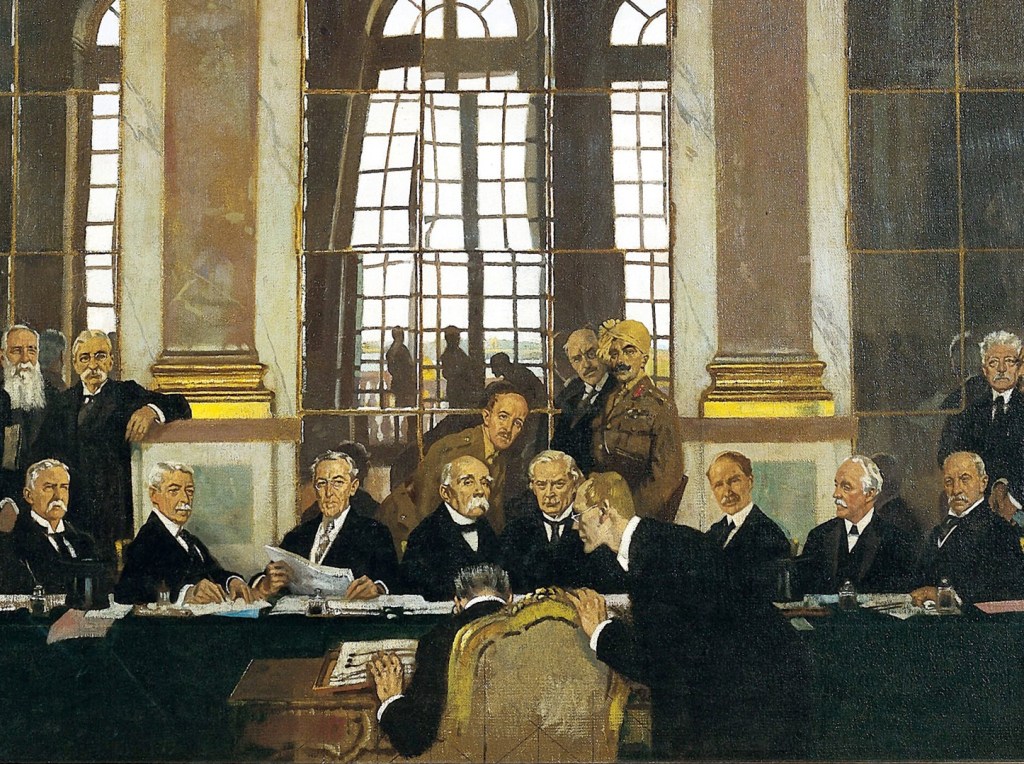
Think of the immediate post-First World War period and the Paris Peace Conference will immediately come to mind. German reparations, disarmament and the League of Nations will probably ensue. Some of you would probably have heard of minorities, notably as a ‘problem’ in the eastern part of Europe that the Conference and the following League tried to solve. Most of these minorities, a few would also point out, were made of people who identified as Germans. Yet, very few of you would add that German minorities existed also in western Europe, notably in Belgium, France and Italy, which, at the end of the Great War, annexed territories with sizable German-speaking populations.
A paper written by Emmanuel, Alessandro and Volker Prott (from Aston University Birmingham), which has just been published in The Nationalities Papers, examines precisely this topic in a comparative perspective. The paper points out that in most accounts of peacemaking after the First World War, ‘flawed’ decisions at ‘Versailles’ caused the ethnically mixed states of central and eastern Europe to descend into violent ethnic clashes, while the allegedly more homogenous western European states faced few issues with minorities.
This article challenges such simplistic view by examining the treatment of German-speaking minorities in the borderlands of Alsace-Lorraine, South Tyrol, and Eupen-Malmedy in the immediate post-war and the early interwar period. Building on an innovative comparative framework of five key variables, the article finds that, in all three cases, post-war borders generated incentives for the respective governments to suppress their new minorities, and that states used ethnic markers to target them. However, the strength of state institutions and liberal principles account for a reversal (Alsace-Lorraine), moderation (Eupen-Malmedy), or hardening (South Tyrol) of measures. Furthermore, international commitment to defend the new borders and the absence of a tradition of ethnic violence also had a significant impact.
The paper is available in First View version at https://doi.org/10.1017/nps.2024.24 and should appear in print later this year or at the beginning of 2025.
A new publication and a new conference presentation by the MoH Team
Many people know the Spanish north-western city of Girona for one of three things: it has offered some of its breathtaking corners to the famous TV series Game of Thrones; it is home to former Catalan President Carles Puigdemont (who has been living in Belgium since the 2017 attempt of his government to convert Catalonia into an independent country); and, in the late 2000s, Ryanair turned its airport into the main gateway to the Costa Brava.
On 2-3 November 2023, the city also became the venue of an international conference on the topic of Global Wilsonism and its Impact on Europe and America. The event gathered about 15 researchers working on different aspects of the so-called Wilsonian Moment, that is a moment between the end of 1918 and the first half of 1919, when President Woodrow Wilson briefly turned into a symbol of peace, justice and self-determination around the world.
In this context, Emmanuel presented a paper written with Mona and entitled Autonomy over Independence: Self-Determination in Catalonia, Flanders, and South Tyrol in the Aftermath of the Great War. The paper argues that, while the impact of the postwar spread of self-determination on the redrawing of eastern European borders and on the claims of colonial independence movements has been extensively researched, the international historiography has paid little attention to minority nationalist movements in western Europe. The text thus focuses on three regions (Catalonia, Flanders and South Tyrol) that experienced considerable sub-state national mobilisation in the interwar period and aims to understand whether the leaders of western European minorities and stateless nations shared the same enthusiasm as their anti-colonial and eastern European counterparts for the new international order that self-determination seemed to foreshadow in the months following the end of the First World War.
The article concludes that nationalist forces in Catalonia, Flanders and South Tyrol initially mobilised self-determination and referred to Wilson as a symbol of national liberation, but this instrumentalisation of self-determination was not sustained. Large-scale mobilisation occurred only in Catalonia, and, even there, it disappeared suddenly in spring 1919. Furthermore, sub-state nationalist movements in western Europe tended to mobilise self-determination to gain regional autonomy, rather than full independence. The willingness of these movements to privilege autonomy over full independence made them more receptive to compromise. Radical forces would become stronger only in the 1930s and largely for reasons not directly connected to the post-war mobilization around self-determination.
The presentation shortly followed the publication of the paper in issue 53(4) of European History Quarterly in October 2023. The paper is available in open access at the journal’s website: https://journals.sagepub.com/doi/full/10.1177/02656914231198182
The MoH team co-organised a conference at the Complutense University of Madrid
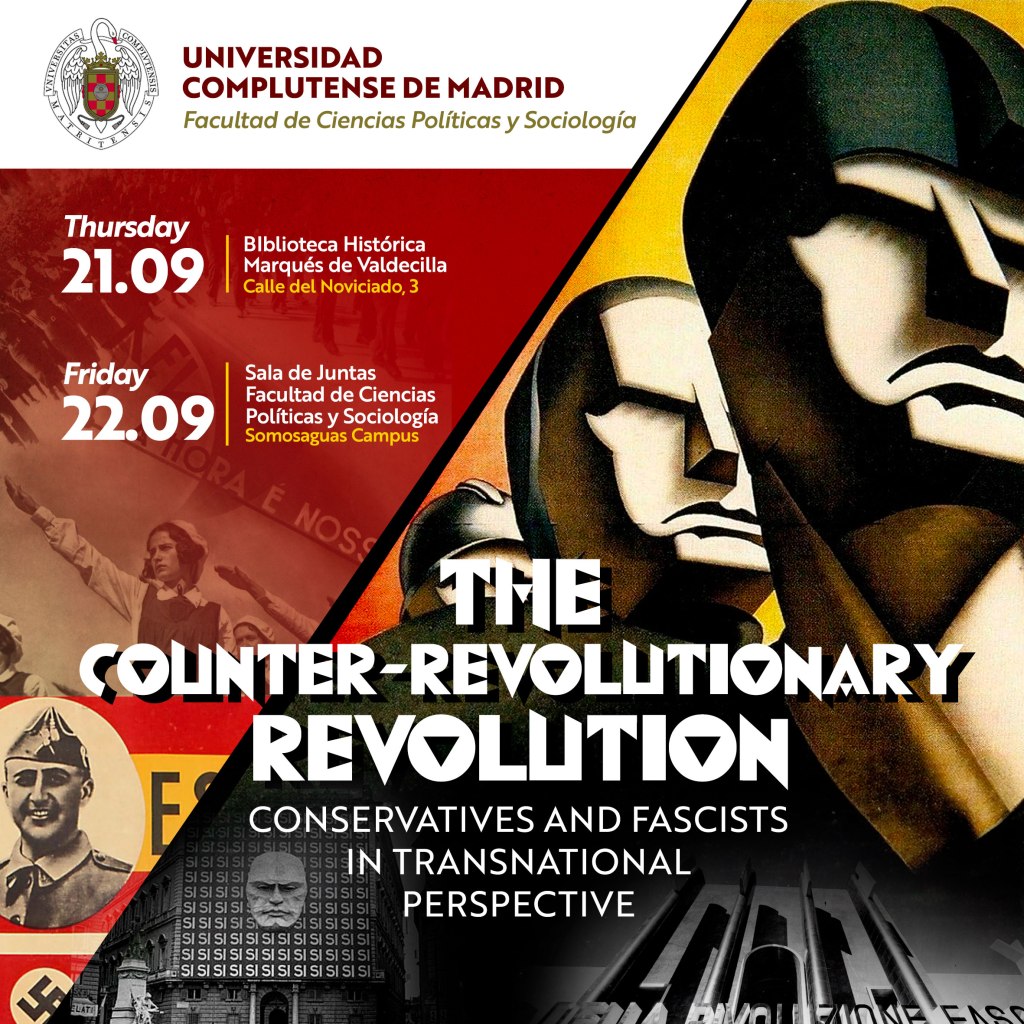
After trade flows, social policy and the environment, the transnational turn has recently impacted the study of conservatism and fascism as well. The MoH team decided to contribute to this trend organising an international conference entitled ‘The Counter-Revolutionary Revolution: Conservatives and Fascists in Transnational Perspective’, which took place on 21-22 September 2023 at the Complutense University of Madrid (co-organised with José Miguel Hernandez Barral, Alejandro Quiroga, Javier Muñoz Soro and Daniele Serapiglia).
In the last few years, the transnational approach has opened up new perspectives for research on the circulation of elements of the ideologies and practices of counter-revolutionary and fascist movements and regimes in inter-war Europe. The transnational approach has also emphasised the initially European and, later, global character of fascism and the counter-revolutionary Right as a response to the crisis of liberalism after the First World War. The conference thus aimed to contribute to the study of fascism and the counter-revolutionary Right as transnational phenomena by focusing on the appeal, external projection and reception of fascist and authoritarian regimes, ideologies and practices in Europe and beyond. Contributions ranged from the March on Rome as a transnational event, the reception of fascism in counter-revolutionary dictatorships in Spain, Portugal and Austria, the adaptation of fascist corporatism in southern European authoritarian regimes and the transnational participation of Italian ‘volunteers’ in the Spanish Civil War.
Emmanuel presented a paper entitled Betting on the wrong horse? Reimond Tollenaere, Staf De Clercq and Nazi transnational support to Flemish radical nationalists, which examined transnational influences, collaborations and dilemmas between radical nationalists in the Flemish-Dutch-German transnational space. There, he argued that the Flemish question during the interwar period embodied the contradictions of an age in which the nationality question that had been ubiquitous in the long 19th century ‘morphed into the minority question’ without disappearing altogether. The quickly nationalising population of Flanders was a demographic majority that, in many ways, behaved as a sociological minority, thus blurring the supposedly tidy lines of division between majorities and minorities, as well as between nationality questions and minority questions.
He also showed that the transnational activities of Flemish extreme-right nationalists and German authorities challenge traditional conception of the relationship between minorities and kin-states. On the one hand, several German actors from the late 19th century onwards identified the Flemings as part of the broader German Volk (as Niederdeutsche). On the other, despite pervasive pan-Netherlandic claims within Flemish nationalist circles, Flemish radicals looked much more towards Berlin than The Hague for support in their struggle for self-determination. Above all, under the Nazi occupation, Flemish extreme-right nationalists who worked to obtain external support, discovered that they were being treated as a German minority that had to be reabsorbed within the larger body of the German Volk. They thus confronted an irresolvable dilemma between their Flemish allegiance and their fascist ideological commitments. Having bet on the wrong horse, they sacrificed their self-determination goals to realpolitik and their allegiance to extreme-right ideals. He concluded that the Flemish story shows the relative and situational nature of the categories of majority, minority and nationality, which are as much self- as hetero-attributed.
The volume is available in hardback and in open access online
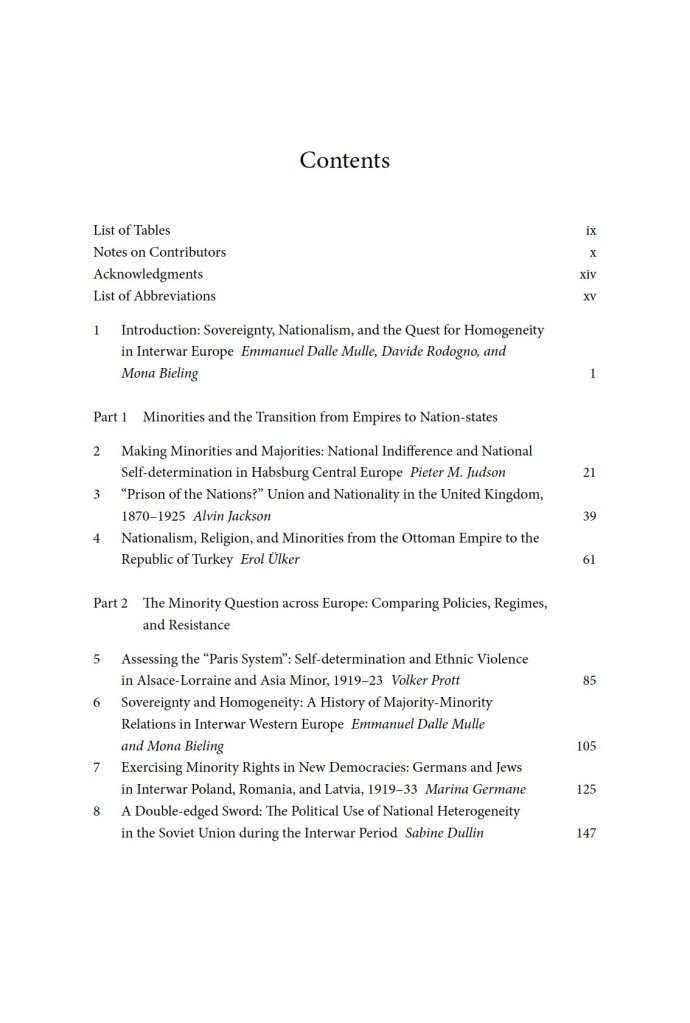
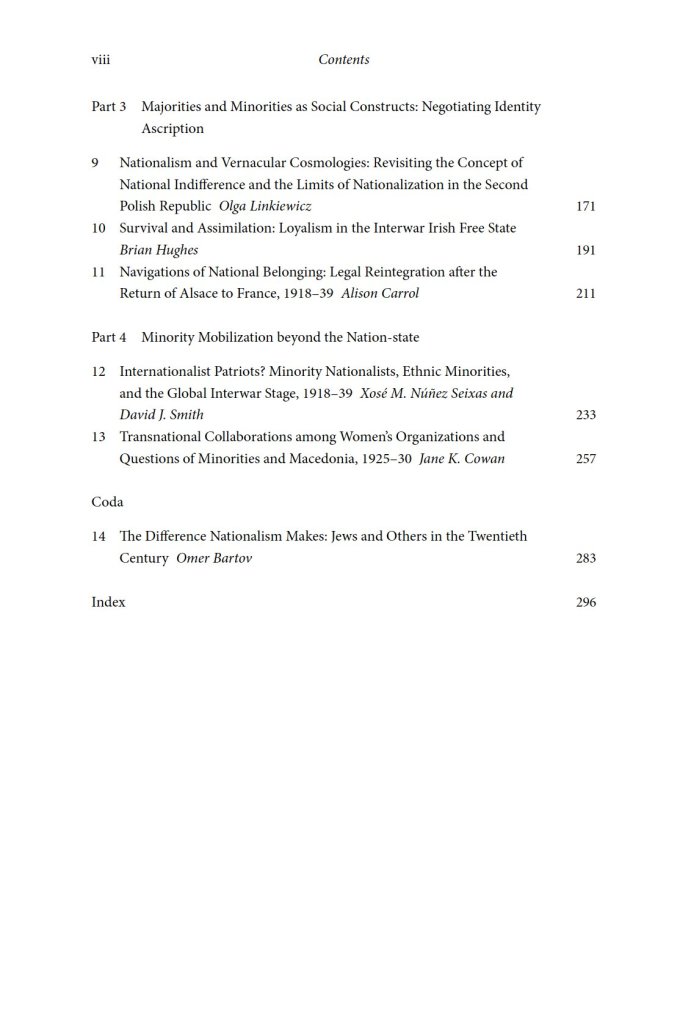
Were European empires ‘prisons of nations’? Did minority questions exist exclusively in eastern Europe during the interwar years? How did ordinary people in minority regions navigate conflicting forms of national identification? How did minority representatives mobilise support for minority rights transnationally? In fourteen chapters, Sovereignty, Nationalism and the Quest for Homogeneity in Interwar Europe answers these and other questions.
Proposing an unusual juxtaposition, the first part of the volume examines three empires (Austria-Hungary, the United Kingdom, and the Ottoman Empire) that, although on different scales, experienced crisis and partition at the end of the Great War. Pieter Judson shows how imperial forms of governance in the Austrian part of the Habsburg Empire gave more space to people to speak their preferred language and to embrace a wider array of self-understandings than the nation-states that followed. The United Kingdom is often examined as a nation-state rather than a union state. By contrast, Alvin Jackson considers it as a composite monarchy and dissects the centrifugal and centripetal forces that led to Britain’s partial break-up, but also to its survival after the First World War. Erol Ülker closes this first part of the volume by examining majority-minority relations in the Ottoman Empire from 1908 to 1923. He concludes that Turkish policies toward non-Turkish minorities were more complex and varied than recognised by traditional accounts.
The second part of the book studies comparatively minority policies in interwar Europe. It demonstrates that minority questions were debated throughout the continent and that the allegedly ‘civilised’ West did not treat minorities more liberally than the supposedly ‘backward’ East. Volker Prott compares violence in Alsace-Lorraine and Asia Minor. He highlights how a temptation to coercively homogenise populations was inherent in the post-war international order, but also identifies factors that restrained large-scale violence. Then, Mona and Emmanuel consider Belgium, Italy, and Spain as nationalising states. They show how these countries adopted homogenising policies with varying degrees of coercion and thus debunk some lingering myths of populations’ homogeneity in interwar western Europe. Marina Germane examines minority policies and mobilisation in Latvia, Poland, and Romania. Following German and Jewish representatives, she investigates the limits of domestic mobilisation and how disillusion pushed activists to move their activities from domestic arenas to the transnational sphere. In the last chapter of this part of the book, Sabine Dullin dissects the USSR’s double-edged nationality policy. She argues that the Soviets promoted national cultures throughout the Union, but also saw minorities as dangerous fifth columns and targets of collective punishment and forced displacement.
Part three of the book examines from the bottom-up processes of identification in different European contexts. It builds upon, but also challenges the national indifference framework. The chapter in this part emphasise how the space for indifference shrank in an increasingly nationalising interwar Europe. Olga Linkiewicz zooms in on rural conflicts in eastern Poland during the 1924 language plebiscite. She shows how peasants behaved in accordance with the principles of a vernacular cosmology that defies easy categorisation as either national indifference or full Polish nationalisation. Brian Hughes explores strategies of everyday resistance among loyalists during and after the Irish Revolution. He dissects the meaning of loyalism, as well as dynamics of integration and assimilation within an increasingly Catholic and Gaelic Irish Republic. Alison Carrol closes this part of the book revisiting Alsace’s return to France. She explores how different groups within Alsatian society pushed the state to adopt flexible policies of integration that created unexpected spaces for alternative understandings of identity.
Part four of the volume follows minority representatives across borders and gauges their efforts to lobby foreign governments, international organisations and the broader international community in favour of the defence of minority rights. Xosé Manoel Nuñez Seixas and David Smith map transnational networks of minority rights advocacy across Europe. They identify the emergence of a transnational nationality theory that, despite its failure, constituted an alternative to the model of the homogenous nation-state in interwar Europe. Jane Cowan explores the triangular, asymmetric and non-reciprocal relation between the Women’s International League for Peace and Freedom (WILPF), Bulgarian and Macedonian female activists and the male-dominated League of Nations. She shows how, in their interactions, these actors navigated hierarchies of gender, class, race, and civilisation.
Omer Bartov closes the book with a broad-ranging coda on the ‘conundrum of national indifference’. National indifference, he argues, rightly reminds us to be sceptical of the arguments of nationalist zealots. The history of the 20th century, as well as the recent Russian aggression of Ukraine, equally reminds us that we downplay the power of nationalism at our own peril. As Bartov and many other contributors suggest, although nationhood was not the only form of identification in interwar Europe, or the most important, the space for indifference shrank considerably between the two World Wars, in Poland and Romania, but also in Italy, France and Ireland.
The Myth of Homogeneity at the Po-His Seminar in Antwerp
Interwar European debates about national conflicts and the preservation of peace were awash with discussions about minority questions and the threat that their mismanagement posed to the preservation of the international order established in Paris. Does that justify treating majorities and minorities as homogenous entities in conflict, or at least in tension, during this period? Although it is clear that at the level of elite discourses and state and international policy there were minority questions in interwar Europe, does this allow us to conclude that European populations were neatly divided into self-conscious majorities and minorities?
On 20 April Emmanuel discussed issues of nationalisation, national indifference and instrumental nationalism in Belgium, Italy and Spain at a session of the weekly seminar of the Power in History (Po-His) research centre at the University of Antwerp. The paper entitled Within Minorities: Repertoires of Instrumental Nationalism in Interwar Western Europe is a draft chapter of the monograph on minority questions in interwar western Europe that Emmanuel is currently writing. The chapter challenges the homogeneity of minority groups in Belgium, Italy and Spain. It explores fluid identities among the populations living in minority areas, often caught between the opposing injunctions of state authorities and minority organisations. The chapter stresses how the boundaries dividing minorities and majorities were unstable and in flux. However, it also shows that in the interwar period, the ‘space’ for indifference towards questions of nationhood and belonging progressively shrunk.
The chapter builds upon and simultaneously moves away from the national indifference framework that since the mid-2000s has dominated studies on nationalism from below. It relies on a conception of nationhood as a property distributed with different degrees of intensity among the individuals of a specific population. While some individuals hold nationhood at the very core of their priorities and have a principled commitment to defending the national cause, others take more instrumental positions on the matter, which favour flexible patterns of behaviour that prioritise alternative, or compatible, forms of identification. Following a distinction proposed by Brendan Karch, the chapter inquires into the chasm between ‘“instrumental” social attitudes towards the nation and “value-driven” nationalism’. Instrumentally-minded actors ‘balanced national loyalties against a field of other commitments and values’, while value-driven activists pursued their national goals ‘nearly regardless of the means necessary to achieve them’.
The chapter applies this framework to different contexts in interwar western Europe. It first looks at the years immediately after the First World War and gauges the degree of mobilisation of minority societies in the context of the so-called Wilsonian Moment, when transnational activists attempted to lobby the great powers and other actors at the Paris Peace Conference in favour of their region’s self-determination, while hoping to rallying the local population in these areas behind their cause. It then moves the gaze to the defence of education in minority language at the regional level in democratic Belgium, especially in the late 1920s and during the 1930s, and in liberal and republican Spain, i.e. before the dictatorship of Miguel Primo de Rivera (in 1923) and during the Second Republic (1931-1936). The chapter examines how ordinary people’s behaviour often frustrated nationalist activists, who wanted to expand the use of minority languages within the school system. Finally, the chapter focuses on the very different context of Mussolini’s dictatorship in Italy and attempts to elucidate how people deemed to belong to minority groups in South Tyrol and Venezia Giulia navigated daily life in the fascist dictatorship through strategies of acceptance, acquiescence, and even enthusiastic collaboration.
Despite the absence of a unique pattern of mobilisation, interwar western European minorities were hardly self-conscious homogenous entities. Even if in most areas cultural and linguistic differentiation from the national majority supposed to identify with and control the state provided potential for national mobilisation, this never automatically translated into political activism. Ordinary people still had room for navigating between competing and complementary self-understandings, related to and beyond nationhood. Yet utter indifference to nationhood became ever more difficult in the radicalised climate of the late 1930s.
The paper received in-depth feedback from the participants in the seminar and Emmanuel is now working on a new version.
H-Nationalism is proud to publish here the ninth post of its “Minorities in Contemporary and Historical Perspectives” series, which looks at majority-minority relations from a multi- disciplinary and diachronic angle. Today’s contribution, by Judith Sijstermans (University of Birmingham), examines the intermixing of populism and nationalism in today’s Flemish politics.
When Flemish nationalism emerged in the 19 th century, despite comprising approximately 60% of the Belgian population, the Flemish people and language were excluded from public administration, the military, politics, law, education and the media. Flanders was dominated by an agrarian way of life, while Wallonia grew through industrialisation. This period of history engendered a feeling of minoritisation, due to Flemish alienation from the centres of Belgian power at the time. This ‘minoritised majority’ mindset forms the foundation of Flemish nationalist ideology today.
However, in practical terms, Flemish fortunes shifted significantly after the Second World War. The Flemish economy now outperforms Wallonia’s following the decline of the Walloon coal and ‘heavy’ industries. The Flemish nationalist message shifted from ‘poor Flanders’ to a ‘nationalism of the rich’ in which Flanders is portrayed as Wallonia’s ‘milk cow’ (Dalle Mulle, 2017). The Belgian state has decentralized, with significant powers devolved to the Flemish and Walloon governments.
Flemish sub-state nationalism is now also characterized by a populist turn, driven by the populist radical right and independence-seeking party the Vlaams Belang (VB, Flemish Interest). In Belgium’s 2019 elections, the VB’s proportion of the vote rose more than 8% at the federal level and 12% in Flemish Parliament elections. The VB’s sub-state nationalist competitor, the Nieuw-Vlaamse Alliantie (N-VA, New Flemish Alliance), remains the largest party in Flanders. However, while it is predominantly a conservative sub-state nationalist party, the N-VA also incorporates populist messaging, particularly directed at Belgian government elites (Van Haute, Pauwels and Sinardet, 2018).
Flanders is not a prototypical case of a minority nationalist movement. It does not represent a minority (demographically or economically) and is increasingly identified by populist rather than autonomist viewpoints. In this blog, I further detail how the Flemish sub-state nationalist approach has incorporated populist narratives and delve into how this populist turn has also led to the adoption of an identitarian approach. In these ways, the Flemish nationalist movement is typical of other emerging patterns of European politics.
Adopting a Populist Sub-state Nationalist Narrative
Populism, academically and politically, has become an inescapable part of the political zeitgeist. For the sake of space and time, I adopt the dominant understanding of the term of populism from political scientist Cas Mudde: populism is a thin-centred ideology concerned with the division between the ‘pure people’ and ‘corrupt elite.’ Populist rhetoric, precisely because of its thin centred nature, fits smoothly in with nationalist ideologies.
Statements from both the N-VA and the VB show how advocating for territorial autonomy can be supported by populist rhetoric. For example, in response to the latest Belgian government formation, which kept both Flemish nationalists parties out, the N-VA placed themselves on the side of the ‘people’: “The N-VA will do everything we can from ourpolitical position during the coming legislature to protect the Flemish people as much as we can from the disastrous plans of this government.” While they raised issues around the legitimacy of the government, the party ultimately stuck to its conservative critique, particularly emphasizing opposition to new taxation.
The Vlaams Belang’s language has been more explicitly populist. The party called the new government an “undemocratic monster coalition” and critiqued the government for increasing the number of jobs, rather than being ‘among the people.’ They emphasized that the government lacked a Flemish majority and that this was seen as a betrayal from ‘traditional parties’ who ‘allowed themselves to be bribed for jobs.’ For both the N-VA and the VB, one elite enemy is the Belgian state. However, for the Vlaams Belang, the Belgian state is not the only enemy of the ‘pure people.’ The VB has also critiqued academics, teachers, journalists and other media professionals as antagonistic to the people (De Cleen, 2016).
Globalization and global elites are also a target. For example, in the party’s membership magazine, VB leader Tom van Grieken critiqued the UN’s Migration Pact. He argued that this was indicative of a wider problem:
“These disconnected globalist elite do not stand alone. Because ivory towers don’t only stand in New York. They also stand in Europe. They also stand in Brussels…The one group is the left side—who eagerly welcome all these new foreign voters—and the other group are the neo-liberals who see this new wave of immigrants as an army of new cheap workers. These two groups get along so well that a clear new political ault line has been created. Namely on one side, left multiculturalists and liberal globalists (united in a coalition against our people) and on the other side patriots, the nationalists that defend ordinary people” (VB Magazine, January 2019)”.
With the increasing electoral power of the Vlaams Belang, sub-state nationalism becomes one part of the movement. However, it is clear that Flemish autonomy from the Belgian state is interwoven with an anti-elite search for autonomy from broader local and international ‘elite’ who are portrayed as corrupt, anti-democratic, and in opposition to the Flemish volk (people).
An Identitarian Evolution for Flemish Cultural Nationalism
Just as the Flemish people are pitted against these elites, Flemish culture is pitted against a ‘liberal’ or ‘left wing’ culture which is seen as being diffused through the media and education. The Vlaams Belang and the N-VA have both, for example, advocated for cutting cultural subsidies, particularly for new or emerging projects. The parties were accused by left wing Flemish parties of targeting funding that would support artists not engaging in ‘traditional’ Flemish art or working with Flanders’ migrant communities. One VB Parliamentarian, Klaas Slootmans, was quoted in Politico as saying: “We back the [N-VA led] government if it wants to cut back on experimental art that is good at spitting in the face of the Flemish.”
The Flemish Movement emerged initially in defence of the Dutch language. Early Flemish nationalists were middle class intellectuals concerned with promoting the use of the Dutch language and using that language to defend the ‘spirit’ of the Flemish people (Dewulf, 2012). In 2020, this linguistic nationalism is only one part of a wider nativist ‘defence’ of Flemish culture.
The Vlaams Belang’s cultural nationalism has been supported by identitarian messages. The identitarian movement is concerned with the defence of a particular ‘European’ identity based on an imagined historical cultural landscape, which was homogenous. Identitarian groups describe migration as a ‘replacement’ of white Europeans with migrants and particularly criticise Muslim migrants. The movement is characterized by the use of social media and YouTube, and a purposeful ambiguity about its goals.
The identitarian approach to Flemish nationalism has been spearheaded by VB MP Dries van Langenhove, who founded the Flemish and right wing youth group Schild en Vrienden (Shield and Friends). Van Langenhove was quoted in the March 2019 Vlaams Belang members magazine promoting a nostalgic nationalism: “The feeling of guilt that has been fed to us since May 1968, and that every European has been carrying since World War Two may well push Europe into the abyss definitively…it ensures that citizens everywhere in Western Europe no longer put their country and people first.” Like the language of putting Flanders first, Vlaams Belang politicians use the language of ‘making Flanders great again’ and supported Donald Trump. Party leader Tom van Grieken tweeted: “The rise of Trump is not an isolated phenomenon. In Europe too, more and more voters want real change.”
In his work on ‘master frames’, Rydgren (2005) showed that radical right messaging in the 1970s and 1980s did not emerge independently in each European country. Rather, it diffused transnationally, particularly from France’s Front National. The VB’s founding members had a close relationship with the Front National and adopted this master frame. The current identitarian messages and outreach to the Trump movement shows that transnational diffusion of radical right nationalist narratives continues today.
However, ultimately, it is the Vlaams Belang’s particular brand of nationalism which is now on the rise in Flanders. In an October 2020 poll, the VB gained 27.1% of the support compared to the N-VA’s 22.2%. The party’s populist narratives link Flemish autonomy with a wider search for autonomy from globalization. The expanded scope of Flemish nationalism can also be seen in the way that the Flemish Movement has begun to promote different forms of cultural nationalism, and nativism.
The Flemish Movement is not prototypical of sub-state nationalism. However, examining the evolution of the Flemish Movement provides an insight into complex intersections between nationalism, populism, and nativism which are increasingly relevant beyond Flanders as well.
Alternative transnational narratives about Flemish sub-state nationalism also emerge. The N- VA, for example, has continued to ally itself with sub-state nationalists in Catalonia, showing support during and after the Catalan independence referendum. Most recently, the N-VA’s Flemish Minister President Jan Jambon spoke out against sanctions made against Catalonia’s President Quim Torra. The Vlaams Belang also looks to other sub-state nationalist movements, with representatives expressing interest in the Scottish independence process, for example.
Sources
Dalle Mulle, E. (2017). The nationalism of the rich: discourses and strategies of separatist parties in Catalonia, Flanders, Northern Italy and Scotland. Routledge.
De Cleen, B. (2016). Representing the People: The Articulation of Nationalism and Populism in the Rhetoric of the Vlaams Belang. In J. Jamin (Ed.), L’Extrême Droite en Europe (pp. 223-242). Brussels: Éditions Bruylant.
Rydgren, J. (2005). Is extreme right‐wing populism contagious? Explaining the emergence of a new party family. European journal of political research, 44(3), 413-437.
Van Haute, E., Pauwels, T., & Sinardet, D. (2018). Sub-state nationalism and populism: the cases of Vlaams Belang, New Flemish Alliance and DéFI in Belgium. Comparative European Politics, 16(6), 954-975.
Judith Sijstermans is a Research Fellow in the Department of Politics and International Studies (POLSIS) in the University of Birmingham. She is currently working on an ESRC funded project ‘The survival of the mass party: Evaluating activism and participation among populist radical right parties (PRRPs) in Europe’ (aka “Populism In Action”) (ES/R011540/1).
The Minorities in Contemporary and Historical Perspective series is organized by the Myth of Homogeneity Research Project at the Graduate Institute of International and Development Studies, Geneva, and the Centre on Constitutional Change at the University of Edinburgh.






 The Myth of Homogeneity